What Should an AI Startup Look For in an NYC Office?
Beyond rent, five things decide whether an office works for an AI company: electrical capacity and cooling, which matter if any hardware sits on-site; fibre and redundant connectivity; a floor plate that suits open engineering seating with enough enclosed rooms; a lease term matched to hiring uncertainty, with expansion rights; and a commute that does not cost you candidates. Rent is the number founders compare and rarely the one that determines whether the space works.
Updated 2026-09-30 · Power, plate, term, commute · Nomad Group
 William JanetschekCo-Founder, COO · Nomad Group
The checklist, in priority order
We open every search with the same six checks, run in the same order, because each one is cheaper to answer than the one below it.
- Transit reach, scored in transfers rather than minutes, for the team you have and the one you plan to hire next year
- Power and cooling, confirmed by a letter from the building's engineer whenever any hardware will run on-premise
- A room ratio of one enclosed room per eight people plus phone booths, since video-heavy teams live behind doors
- Expansion paper, meaning first-offer rights on adjacent space or a shorter term, as the hedge against a fast-moving headcount
- A single-tenant floor with a keyed elevator, so the culture inside the door is entirely yours
- Honest economics, which to us means a published asking rent, transparent operating costs, and a TI allowance argued from a priced buildout rather than a round number
Everything else, the exposed brick, the roof deck, the lobby art, is taste, and taste is a fine tiebreaker once the six are satisfied. These six are the difference between an office that helps the company and one that merely houses it.
Transit first, always
Recruiting outcomes track commutes more tightly than they track any feature of the office itself, which is why we score transit before we score anything else. The spine of this corridor, Union Square up through Flatiron, puts every borough within one transfer, and that reach is the reason the cluster formed where it did rather than somewhere cheaper. Fighting the cluster costs offer-acceptance points, quietly and every quarter, and no landlord concession shows up on that line of the ledger. So before you admire a floor's light, pull the home stations of the candidates actually sitting in your pipeline and score the floor in transfers from each of them. A floor that scores well on that exercise can survive an ordinary layout, while a floor that scores badly will fight you on every offer you extend.
The fabric of the floor itself
Most of this corridor, and nearly all of our book, is prewar loft stock, which buys you high ceilings, big windows, and single-tenant privacy at the price of building-by-building variance. Elevators, electrical capacity, and HVAC in these buildings need checking rather than assuming, so walk your finalists at midday for the light and again at 6pm for the noise, get the engineer's specifications in writing, and pay for a test fit on the last two floors so the desk count comes from a space planner's drawing rather than brochure arithmetic.
On sizing, we plan at 175 square feet a person all-in. A 20-person team therefore tours around 3,500 square feet and a 50-person team around 8,750, which in practice means a floor like 127 West 26th Street's entire 7th, 9,500 square feet in Chelsea at $50, sits squarely in a 50-person team's range, while the big prewar plates in the book, One Soho Square's partial 2nd floor and the 151 West 26th Street penthouse among them, hold a company planning well past that. Our current floors run from 2,978 to 27,344 square feet, with rents from $43 to $115 published on every one.
Terms that protect a fast-growing company
Free rent at roughly a month per lease-year is customary in this market, not a favor the landlord is extending you, so treat it as the floor of the conversation rather than the win. A tenant improvement allowance funds a real fraction of the buildout when it is negotiated against a priced design, and a token fraction when it is negotiated against a guess. Sublet and assignment rights are the escape hatches a startup should never sign without, whatever the term. And the Good Guy Guarantee, the personal guarantee this market treats as standard, turns out to be survivable once you understand what it does and does not reach, which our glossary page explains in two minutes.
The larger point is to negotiate from published numbers. Every rent on this site is the real asking figure precisely so the conversation starts honest, and a tenant-only broker, which is all we are, has no reason to want it any other way.
The walkthrough test, codified
We run the same twenty minutes on every tour, and we would run it with or without a client in the room. Stand at the worst desk on the floor and judge the light from there, not from the corner by the windows. Take a call in the loudest spot you can find. Count the enclosed rooms against one-per-eight. Open the electrical closet and photograph the panel for your engineer. Ride the freight elevator, not just the passenger cab. Then ask the super, not the broker, what after-hours HVAC costs and when it actually runs. Floors fail this test in ways no brochure can show, and the twenty minutes has saved our clients from more than one bad year.
Seven of our floors carry full 3D scans, which means roughly half the test now runs before you leave your desk. Count the rooms and judge the light from the walkthrough, then spend the physical tour on the closet, the freight elevator, and the super.
Red flags specific to this tenant profile
The flags below recur with this tenant profile often enough that we name them on the first call.
- Any hedge on the power question, because 'should be fine' is a sentence and a letter from the building's engineer is a document
- Meeting rooms drawn at one-per-fifteen, which leaves a video-heavy team fighting over doors by month two
- A shared-corridor floor pitched as private, when your whiteboards and your roadmap deserve a keyed elevator
- Restoration clauses on heavy fit-outs, because hardware rooms are expensive to build and more expensive to un-build
- A term that outruns your forecast with no sublet escape, since growth risk cuts both ways and the lease should too
Every one of these has a standard counter when it is named early, and every one is expensive when it is discovered late. Naming them early is what a search, properly run, actually consists of.
How the checklist plays out on a real tour
Take the checklist into a real afternoon, three floors in one submarket over two hours. At the first floor the light test fails quietly, because the worst desk sits twenty feet from a window that faces an airshaft, and no fit-out budget in the world fixes orientation. At the second the room count passes, but the electrical closet photographs a panel from 1987, and the engineer's letter that follows prices the upgrade at five figures, which becomes a line in the TI negotiation rather than a surprise after signature. The third floor passes everything, and the freight elevator turns out to be booked solid on Tuesdays, which moves the buildout schedule and moves nothing else.
That afternoon is the checklist doing its job. Three floors produced three different verdicts, and each verdict rested on evidence rather than atmosphere. The floor that wins is rarely the prettiest of the three; it is the one whose problems were known, priced, and negotiated before anyone signed anything.
The remote version now runs nearly as well as the physical one. Seven floors on this site carry full 3D walkthroughs, so the light test and the room count happen from a laptop, and the physical tour spends its two hours on the closets, the supers, and the elevators, which are precisely the things a scan cannot show you. Distributed founding teams shortlist this way by default now, and the one flight that follows lands with the decision half-made.
However you run it, insist on the full twenty minutes per floor. Every expensive office mistake we have been called in to fix was visible in that twenty minutes, and in every case the twenty minutes had been skipped.
The one-page brief that starts it right
Everything above compresses into a brief you could write tonight. It holds the eighteen-month headcount and the square footage that headcount implies, the two neighborhoods your transfer scoring chose, the monthly ceiling with operating costs included, a yes-or-no answer to the power question, the room ratio your meeting culture needs, and the three lease rights you will not sign without, meaning sublet, assignment, and expansion. One page, six lines, and every later decision has an anchor to pull against.
A search that starts from that brief tours six floors instead of sixteen, negotiates from positions instead of reactions, and closes in the quarter your hiring pipeline promised. A search that starts without it discovers the brief the expensive way, one mismatched floor at a time, usually with a signed lease somewhere in the middle.
Send us the brief itself if you have it, or just the three numbers if you do not, and the first shortlist will show you which floors on the live book already satisfy it, with the rents printed, the scans linked, and the arithmetic already run.
What matters more than rent?
Commute and floor plate. A cheaper office that costs two senior hires is expensive. A floor that cannot be laid out for the way your team works will be wrong for the whole term, whatever it cost.
Do AI companies need special infrastructure?
Sometimes. Teams running on-premise GPU hardware need electrical capacity and cooling most buildings do not advertise, and the answer must come from the building's engineer before signing. Teams entirely on cloud need fibre and redundancy, a lower bar, but still worth verifying.
How many enclosed rooms are needed?
Roughly one per 8–10 people, plus phone booths at about one per 12. Video-heavy AI teams need more booths than a standard fit-out provides, and this is the most common thing to get wrong.
What lease terms protect a growing team?
Expansion rights on contiguous space, a right of first offer on adjacent floors, sublet rights, and a term matched to your forecasting horizon rather than to the landlord's preference.
Matching space available now
-
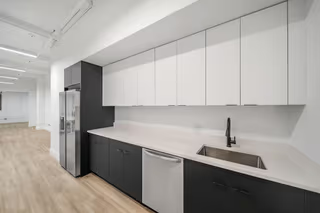 153 W 27th Street [Partial 3rd Floor] 2,978 sq ft $44/sq ft Chelsea
 -
 6 Greene Street [Entire 2nd Floor] 4,900 sq ft $78/sq ft SoHo
 -
 30 West 21st Street [Penthouse floor] 5,250 sq ft $115/sq ft Flatiron
 -
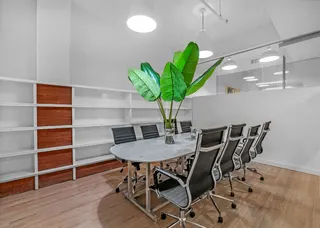 276 Fifth Avenue [9th Floor] 5,500 sq ft $52/sq ft Flatiron
 -
 50 Greene Street [3rd Floor] 7,300 sq ft $98/sq ft SoHo
 -
 137 East 25th Street [6th Floor] 8,308 sq ft $43/sq ft Flatiron
The team
The people you'll actually deal with
Tenant-side brokers, builders and operators, 300+ New York offices delivered between them.
Meet the whole team → Matthew DeRose
 Megan Gallagher
 Nicholas Hein
 Adam Justin
 David Greene
Talk to a broker
Availability moves daily, get today's version
The spaces above are current as of this week. Tell us team size and timing and a broker sends today's live list for this exact search, with all-in monthly costs, and anything new that has not been published yet.
- Same daya broker replies personally, no automated triage
- Tenant-onlyNomad never represents the landlord
- Open pricingrent and size published before you talk to anyone
- 300+ officesdelivered across 2M+ sq ft in New York
Or call 646-688-3158