Best NYC Office Neighborhoods for Hiring AI Talent
For hiring engineers in New York, the strongest submarkets are Flatiron, NoMad, Union Square, SoHo and Chelsea, collectively Midtown South. They win on commute reach rather than prestige: Union Square alone connects the 4/5/6, N/Q/R/W and L, putting Brooklyn, Queens and the Village within a short ride. Current asking rents across these run $43–$125 per square foot per year.
Updated 2026-09-30 · 5 submarkets compared · Nomad Group
 William JanetschekCo-Founder, COO · Nomad Group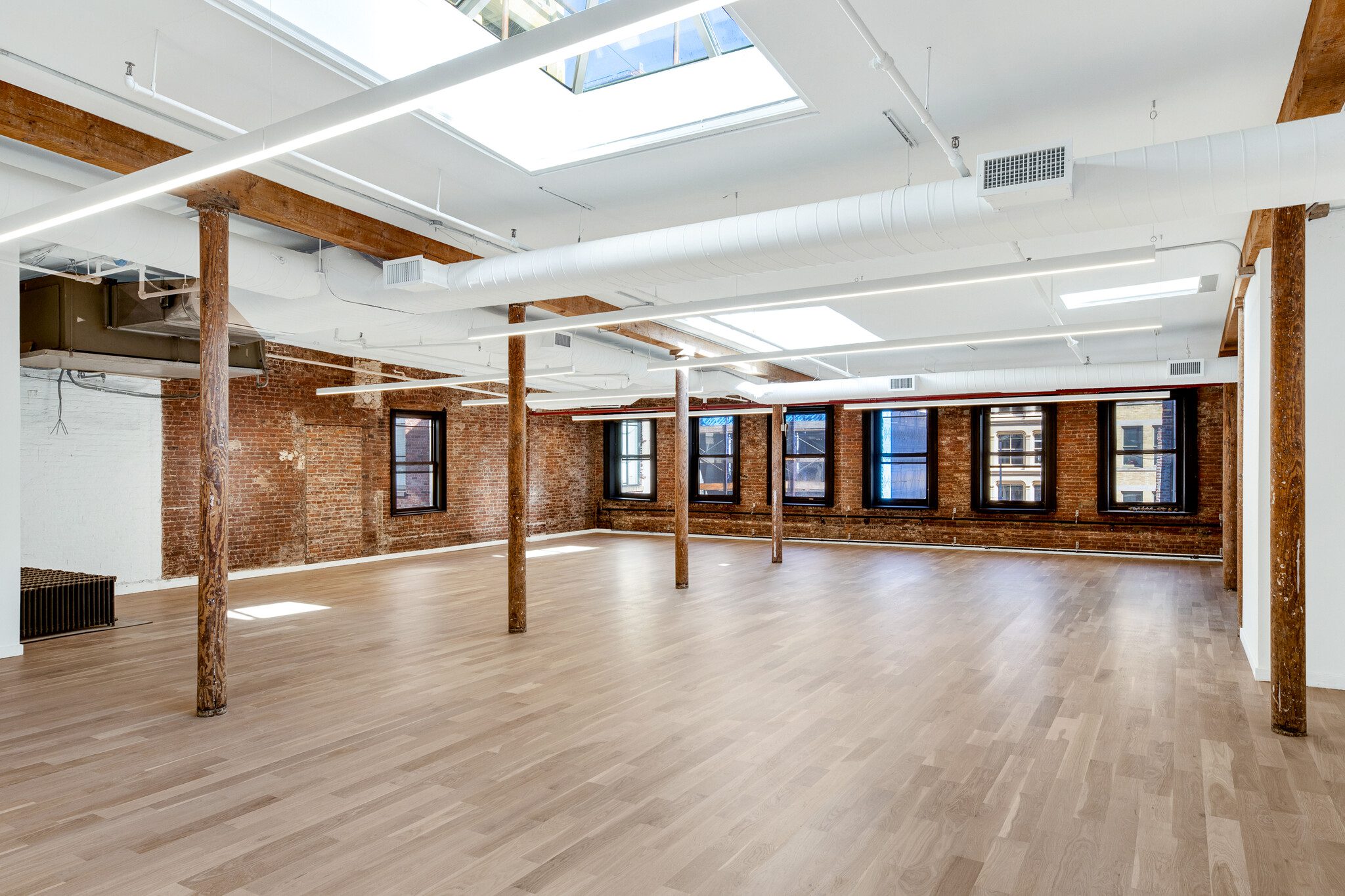
The way to actually run this decision: collect the home stations of the team you have and the candidate pool you want, then count transfers, not minutes. A commute with zero or one transfer gets accepted; two transfers gets negotiated against. Weight the map by the roles you'll hire hardest for, not by headcount. Then remember the cluster effect works in both directions, locating among other AI companies makes hiring easier and retention harder, because the next offer is a lunchtime walk away. Transit reach fills the funnel; what happens inside the office decides whether the cluster poaches from you or you from it.
How to actually run this decision
Neighborhood debates burn weeks inside young companies because they are usually run on taste, and taste is unfalsifiable. Run this one on data you already hold. Collect the home subway stations of everyone you employ today and of the last fifty candidates you interviewed, then score each neighborhood by transfer count rather than by minutes on a map. A transfer is what makes a commute feel long, since the waiting and the platform-changing register far more heavily in a candidate's mind than time spent in a moving train, and the difference between zero transfers and one shows up directly in offer-acceptance rates for senior candidates.
Run properly, the exercise produces a two-neighborhood shortlist in a single afternoon, and it converts the office decision from a founders' argument about atmosphere into an operations question with a defensible answer. Everything below is input to that scoring, not a substitute for it. The founders who resist the exercise tend to be the ones it helps most, because the scoring surfaces the commutes nobody had thought to mention while the debate stayed at the level of atmosphere.
The five that matter, and what each is for
- Union Square and Flatiron are the reach champions. The 4/5/6, N/Q/R/W and L put every borough and the PATH within one transfer. Rents on our current book run $43 to $115, and the practical band, where most deals land, is $45 to $65.
- Chelsea is the value pick with the Google halo. Asking rents run $44 to $64, the neighborhood is strongest for candidates riding the A/C/E and 1 corridors, and it is weakest for anyone commuting from the east side.
- NoMad delivers Flatiron-grade stock at a modest discount, $57 to $62 on the loft floors and $90 at the Empire State Building, along with the best food fabric per dollar anywhere in the corridor.
- SoHo is the brand address at $68 to $125, and it pays for itself when design and consumer talent sits at the top of the hiring plan, because those candidates weigh the block itself more heavily than engineers tend to.
- Penn Plaza, at about $51, is the suburban-commuter answer, one avenue from the lofts at the lowest rent on our book, and the right call when the executive layer rides commuter rail.
All five sit inside Midtown South, so the real spread between them is minutes wide and dollars deep. The same 40-person office costs about $24,000 a month in Penn Plaza and $38,000 in SoHo, and nothing in the commute math justifies that gap on its own. What justifies it, when it is justified, is the profile of the people the company needs to hire next.
What engineers actually weigh
Every candidate survey we have seen, and every debrief our clients share after a hard-fought offer, comes back to the same three variables in the same order. Engineers weigh total door-to-door time, the number of transfers inside that time, and whether the block around the office has any life after 6pm. Amenity floors and roof decks poll far below all three, which argues for spending on location before spending on fit-out. A mid-grade floor at Union Square out-recruits a showpiece two transfers away, and it keeps doing so every quarter, not just in the month you sign.
The one amenity that does move senior candidates is a real desk in a real office rather than a coworking pass, because a lease signals permanence in a way no perk can imitate. If the budget forces a choice, choose the lease over the ping-pong table.
The clustering effect
AI companies concentrate, and the concentration compounds on itself. Flatiron and Union Square inherited the original Silicon Alley cluster, and Chelsea inherited Google's orbit, so the map was largely drawn before this generation of companies arrived to redraw it. Sitting inside the cluster means your candidates already commute to those blocks for the jobs they hold now, your investors already walk them between meetings, and the coffee-meeting radius around your front door takes in half your future hires.
Against all of that, rents inside the cluster carry a premium of roughly 10 to 20% over equivalent stock outside it. Our judgment, formed by watching which offices actually help companies hire, is that the premium is worth paying while the company is in hiring mode, and worth reconsidering only once the team is built and retention has replaced recruiting as the harder problem.
Make it concrete against live floors
Theory ends at a walkthrough, and no amount of scoring substitutes for standing on a floor with the people who will sit on it. The floors linked on this page are our live availability inside these neighborhoods, each carrying its real asking rent, its square footage and its desk count in the open rather than behind a form. The useful sequence is to shortlist two neighborhoods with the transfer exercise, then walk one floor in each on the same afternoon. The contrast between a $43 floor on East 25th Street and a Greene Street loft teaches more in two hours than any guide can, because the difference stops being a number on a spreadsheet and becomes a room you have stood in. We set up those same-afternoon pairings routinely, and it is almost always the second walkthrough where a client discovers what the budget is really buying.
Worked example: one plan, scored
Here is a composite drawn from recent searches. The company employs 28 people today and is hiring to 55, engineering-heavy with a design pod, and the current team clusters in Brooklyn and Queens with two executives commuting in from the suburbs. Transfer scoring puts Union Square and Flatiron clear first, because the L and the express lines carry the borough cohort directly while Grand Central's rails cover the executives at one crosstown hop. Chelsea scores a transfer worse for the Brooklyn contingent, and SoHo splits the difference at a premium the hiring plan does not obviously repay.
The shortlist that method produced was 137 East 25th Street's 8,308 feet at $43 as the value anchor and a 30 West 21st Street floor as the stretch. The rent delta between the two runs about $8,000 a month, which means the founders are now having a priced argument instead of a debate about vibe, and priced arguments get settled.
What changes as the team doubles
Neighborhood economics shift with scale, and it pays to know which regime you are operating in. Under thirty people, the rent spread between districts is real but survivable, and taste can legitimately win the argument. Past fifty, the spread compounds into six figures annually while the transit scoring hardens at the same time, because every transfer now multiplies across many more daily commutes. That double squeeze is why growing companies drift toward the reach champions even when they started somewhere quirkier and genuinely loved it there.
Plan the neighborhood for the eighteen-month team the same way the square footage gets planned. The office that fits the people you are about to hire beats the office that flatters the people you were.
From scoring to signature
The endgame of the method is mercifully short. The transfer scoring names two neighborhoods, the published rents turn them into a priced shortlist the same afternoon, and one walking tour settles what the spreadsheet could not, since this corridor packs five submarkets into a fifteen-minute radius. Companies that run the decision this way tend to sign inside a month and defend the choice effortlessly afterwards, because the reasoning was written down before anyone fell in love with a view.
The floors linked on this page update with the live book, so the shortlist you build today is buildable today, with every rent real and seven of the floors walkable in 3D before anyone leaves a desk. Hiring plans move fast in this sector. The neighborhood decision, run properly once, should never need to move with them.
If you would rather have the scoring run for you, send us the team's home stations along with the three numbers that anchor any search, meaning headcount today, headcount at eighteen months and the budget. It takes us a morning, and the shortlist arrives with the transfer arithmetic attached rather than asserted.
Keep the scoring sheet after you sign. The same spreadsheet that chose the neighborhood becomes the baseline for every future office decision, the renewal, the satellite, the next city, and the discipline it encodes outlives any single lease. Method compounds. Taste just repeats itself a little more confidently each time.
Which NYC neighborhood is best for hiring engineers?
Union Square and Flatiron, mainly for transit. Union Square carries the 4/5/6, N/Q/R/W and L, which means a candidate in Williamsburg, Astoria or Park Slope has a direct ride. Commute length is one of the few office factors that measurably affects acceptance rates.
Why do AI companies cluster in Midtown South?
Three reasons: subway convergence, loft floor plates that suit open engineering teams, and proximity to other AI companies, which matters for hiring, since engineers move between firms within walking distance.
Is a cheaper neighborhood worth it?
Sometimes. Penn Plaza and parts of Midtown price below the Midtown South cluster with comparable transit. The saving is real, but if a longer or more awkward commute costs you two senior hires, the rent difference is irrelevant.
What is available in these areas now?
31 spaces across Flatiron, SoHo, Chelsea, Union Square and NoMad, with rents published openly on each listing.
Matching space available now
-
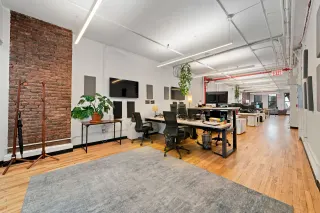 29 West 17th Street [Partial 7th Floor] 2,500 sq ft $60/sq ft Union Square
 -
 153 West 27th Street [Partial 11th Floor] 2,937 sq ft $60/sq ft Chelsea
 -
 900 Broadway [Partial 9th Floor] 2,940 sq ft $92/sq ft Flatiron
 -
 153 W 27th Street [Partial 3rd Floor] 2,978 sq ft $44/sq ft Chelsea
 -
 115 West 30th Street [Partial 4th Floor] 3,500 sq ft $55/sq ft Chelsea
 -
 110 Greene Street [Partial 5th Floor] 3,750 sq ft $95/sq ft SoHo
The team
The people you'll actually deal with
Tenant-side brokers, builders and operators, 300+ New York offices delivered between them.
Meet the whole team → Matthew DeRose
 Megan Gallagher
 Nicholas Hein
 Adam Justin
 David Greene
Talk to a broker
Availability moves daily, get today's version
The spaces above are current as of this week. Tell us team size and timing and a broker sends today's live list for this exact search, with all-in monthly costs, and anything new that has not been published yet.
- Same daya broker replies personally, no automated triage
- Tenant-onlyNomad never represents the landlord
- Open pricingrent and size published before you talk to anyone
- 300+ officesdelivered across 2M+ sq ft in New York
Or call 646-688-3158