How to Find Office Space for an AI Company in NYC
AI companies in New York concentrate in Midtown South, Flatiron, NoMad, SoHo, Chelsea and Union Square, where asking rents currently run $43 to $200 per square foot per year against a median of $75. The practical route is to fix headcount at 12–18 months out, budget about 175 sq ft per person, then work with a tenant-only broker who can show pre-built floors and negotiate a buildout allowance. Nomad has delivered 300+ office buildouts and 2M+ sq ft across these submarkets and represents tenants exclusively.
Updated 2026-09-30 · 31 spaces in the tech corridor · Nomad Group
 William JanetschekCo-Founder, COO · Nomad Group
What AI teams need that generic tenants do not
Most of an AI company's office is a normal office, which is to say desks, rooms and decent light, but three requirements come up on nearly every search we run for this sector and generic tours miss all of them. The first is power. If there is any on-premise GPU plan at all, get the building engineer's watts-per-square-foot letter in writing before signature, because electrical capacity across the prewar stock varies wildly from building to building and a retrofit after the fact is never cheap. The second is enclosed space. Research teams run video-heavy and pairing-heavy, so we plan rooms above the standard ratio, one room per eight people plus booths, and no client has ever told us that turned out to be too many. The third is density headroom. AI headcounts move faster than those of any other startup category we serve, which means expansion rights are not boilerplate on these deals. Negotiated properly, they become the most valuable clause in the entire lease.
Where the cluster actually is
New York's AI companies sit in Midtown South, the stretch that runs from Union Square through Flatiron into Chelsea and NoMad, which happens to be the same corridor as every floor on this site. The distribution inside the corridor has its own logic. Flatiron and Union Square carry the historic tech cluster and the best transit reach in the city, Chelsea adds the Google-adjacent halo at a meaningful discount, and SoHo takes the consumer-facing companies whose hiring skews toward design. The numbers underneath that picture are worth having in hand before the first tour.
- The range across current availability runs $43 to $200 per square foot, with the median at $75
- 49 floors are live on this site, from 2,500 to 27,344 square feet
- Every rent is published, so the shortlist math runs before anyone picks up a phone
The clustering pays for itself in hiring. Candidates already commute to these blocks, the coffee-radius effect on recruiting is real however unscientific it sounds, and the sensible posture is to pay the cluster premium while you are hiring hard and to question it later, once the team is built and retention matters more than reach.
Sizing when the plan says triple
Our standing advice is to size for the eighteen-month number at 175 square feet a person, and then to bind the growth in paper rather than in empty desks, through rights of first offer on adjacent floors or shorter terms with pre-agreed renewals. A 20-person team hiring to 50 should be touring 8,000 to 9,000 square feet, and if that feels roomy on move-in day, it is exactly right. Space that fits perfectly on day one is space the plan has already outgrown.
The opposite failure is just as real and considerably more expensive. We have watched teams sign for the stretch case and then carry 40 empty desks through a slow quarter, paying full rent on a forecast that never arrived. The lease should hedge the plan's error bars in both directions, and that hedging, rather than the headline rent, is what the clause negotiation is actually for.
From shortlist to standup
Run in parallel, the whole pipeline fits inside a quarter. Three weeks of touring against published rents, the lease and the buildout negotiated together so the tenant improvement allowance reflects a design that has actually been priced, permits filed at signature rather than after it, and desks on the floor in ten to sixteen weeks for a custom build or two to four for prebuilt space. Seven of the current floors carry full 3D walkthroughs, which means half of the first tour happens from a laptop before anyone books a car.
Getting started takes three numbers, headcount, timing and budget. Send those over and the shortlist lands the next business day with the power and room arithmetic already run for an AI tenant, because at this point AI tenants are most of what we place in this corridor.
The floors AI teams tour first
The live book maps onto team stages more cleanly than you might expect. A 25-person research team with design ambitions tours 6 Greene Street first, a 4,900-foot loft with its own 3D tour. A 45-person team deep in the build phase, where every dollar fights compute for priority, starts at 137 East 25th's 8,308 feet at $43. Once engineering crosses the hundred-desk line, the conversation moves to 275 Seventh Avenue or 1450 Broadway at 17,000-plus feet. All 46 live floors carry published sizes and desk estimates, with rents printed on all but three, so the stage-to-floor mapping runs from a laptop before we ever meet in person.
Seven floors are fully scanned in 3D, and that matters more for AI companies than for most tenants. Distributed founding teams shortlist remotely by default, and for them a good scan does not merely narrow the first tour, it replaces it entirely.
Beyond the lease: keeping the floor at model-team speed
AI offices change faster than anyone else's. Pods reorganize around projects, the booths fill up the moment a research team goes video-heavy, and the espresso machine quietly becomes load-bearing culture. We design for that churn from the first drawing, which in practice means furniture systems instead of built walls wherever the program allows it, spare power drops waiting in the open zones, and at least one flexible room that can become three desks or a war room over a single weekend.
Our construction and facilities teams stay attached after move-in for exactly this reason. The client stories with 3D scans show floors six months after delivery, still recognizable but already rearranged, and in our view that is what a successful delivery looks like. Plan for the churn up front and the office keeps pace with the roadmap instead of lagging a quarter behind it.
The next lease: planning for the company after this one
AI companies outgrow offices faster than any tenant class we serve, so the first lease should be drafted with the second one already in mind. That starts with assignment rights that survive an acquisition, because acquirers inherit leases weekly in this sector and a clean assignment clause is the difference between a footnote in the deal and a genuine complication. It continues with sublet language loose enough to hand the floor to a portfolio company or a friendly team if the plan leaps ahead of the space. And it finishes with expansion rights, first offer on adjacent space, so that growth becomes a weekend of moving desks rather than a second search from scratch.
Keep the exit economics visible while you negotiate. A five-year lease with honest sublet rights is really a three-year commitment with insurance attached, while the same lease with sole-discretion consent is a five-year bet on your own forecast, and forecasts in this sector age in months. The delta between those two documents is a few lawyer-hours at signing, which makes it the cheapest insurance in the entire transaction.
Then log what the space teaches you. Twelve months of real usage, which rooms fill, where people actually sit, what the video load did to the booth ratio, amounts to the design brief for the next floor, gathered for free. The companies that scale their offices gracefully treat each lease as a draft of the next one, and we run the relationship the same way. When the renewal conversation opens, it opens with the usage data rather than the rent roll.
The search, started the AI-company way
The teams this page describes run their searches the way they run everything else, from data, in parallel, and fast, and this site was built for exactly that posture. Published rents give you something real to shortlist from, the walkthroughs let you pre-screen buildings without leaving your desk, the filters answer plain-language queries, and the calculator holds the live median, so the discovery phase that pads out most office searches simply does not happen here.
What no site can automate is the half of the search that decides outcomes, meaning which landlords will actually move, what the building engineer will really commit to in writing, and how this quarter's leverage sits between tenants and owners. That half arrives with the first shortlist once you send us the three numbers, and it is the half where a tenant-only firm earns its keep.
Model teams, infra teams, consumer AI, stealth or loud, the corridor holds your next floor at a printed price, and the pipeline from here to your first standup is one quarter run properly. Start it whenever the plan turns real, and the shortlist will be waiting before your next planning meeting.
Where do AI companies take office space in NYC?
Overwhelmingly Midtown South: Flatiron, NoMad, Union Square, SoHo and Chelsea. The cluster exists because engineers can reach it from Brooklyn, Queens and the Village on almost every line, and because the loft stock suits open engineering floors. Nomad currently has 31 spaces across those five submarkets.
What does it cost?
Asking rents across current availability run $43 to $200 per square foot per year, median $75. A 30-person team needs roughly 5,250 sq ft, so about $32,813 per month before electricity and buildout.
How long does it take?
A pre-built or furnished floor can be occupied in two to four weeks after signing. A custom buildout typically runs 10–16 weeks depending on size and finish level. Nomad manages both the search and the construction, which is why the two timelines can overlap.
Should an AI startup sign a long lease?
Not necessarily. Short-term and flexible structures exist, 12, 24 and 36-month terms, subleases, and pre-built space with negotiated exit rights. The trade is usually rent against flexibility: shorter terms carry a premium, longer terms earn free rent and a bigger improvement allowance.
Matching space available now
-
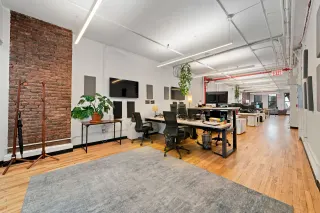 29 West 17th Street [Partial 7th Floor] 2,500 sq ft $60/sq ft Union Square
 -
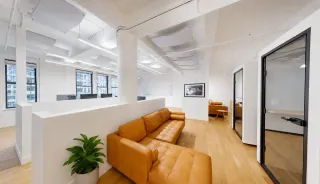 153 West 27th Street [Partial 11th Floor] 2,937 sq ft $60/sq ft Chelsea
 -
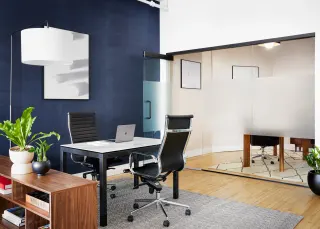 900 Broadway [Partial 9th Floor] 2,940 sq ft $92/sq ft Flatiron
 -
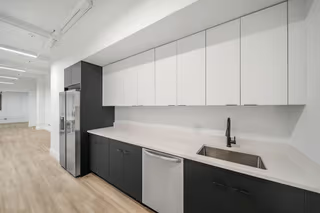 153 W 27th Street [Partial 3rd Floor] 2,978 sq ft $44/sq ft Chelsea
 -
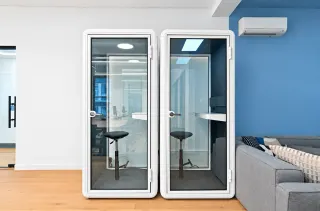 115 West 30th Street [Partial 4th Floor] 3,500 sq ft $55/sq ft Chelsea
 -
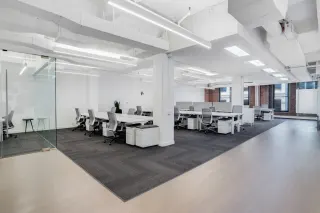 110 Greene Street [Partial 5th Floor] 3,750 sq ft $95/sq ft SoHo
The team
The people you'll actually deal with
Tenant-side brokers, builders and operators, 300+ New York offices delivered between them.
Meet the whole team → Matthew DeRose
 Megan Gallagher
 Nicholas Hein
 Adam Justin
 David Greene
Talk to a broker
Availability moves daily, get today's version
The spaces above are current as of this week. Tell us team size and timing and a broker sends today's live list for this exact search, with all-in monthly costs, and anything new that has not been published yet.
- Same daya broker replies personally, no automated triage
- Tenant-onlyNomad never represents the landlord
- Open pricingrent and size published before you talk to anyone
- 300+ officesdelivered across 2M+ sq ft in New York
Or call 646-688-3158