Opening a New York Office When Your Company Is San Francisco-Based
Opening a New York office from San Francisco is mostly an exercise in unlearning. NYC quotes rent annually per rentable square foot rather than monthly per usable foot, leases run longer, landlords demand a letter of credit rather than a deposit, and buildings are approved through a permitting process with no SF equivalent. Current NYC asking rents run $43–$200 per square foot per year against a median of $75. A 25-person New York team needs about 4,375 sq ft, roughly $27,344 a month.
Updated 2026-09-30 · Second office · SF to NYC · Nomad Group
 William JanetschekCo-Founder, COO · Nomad Group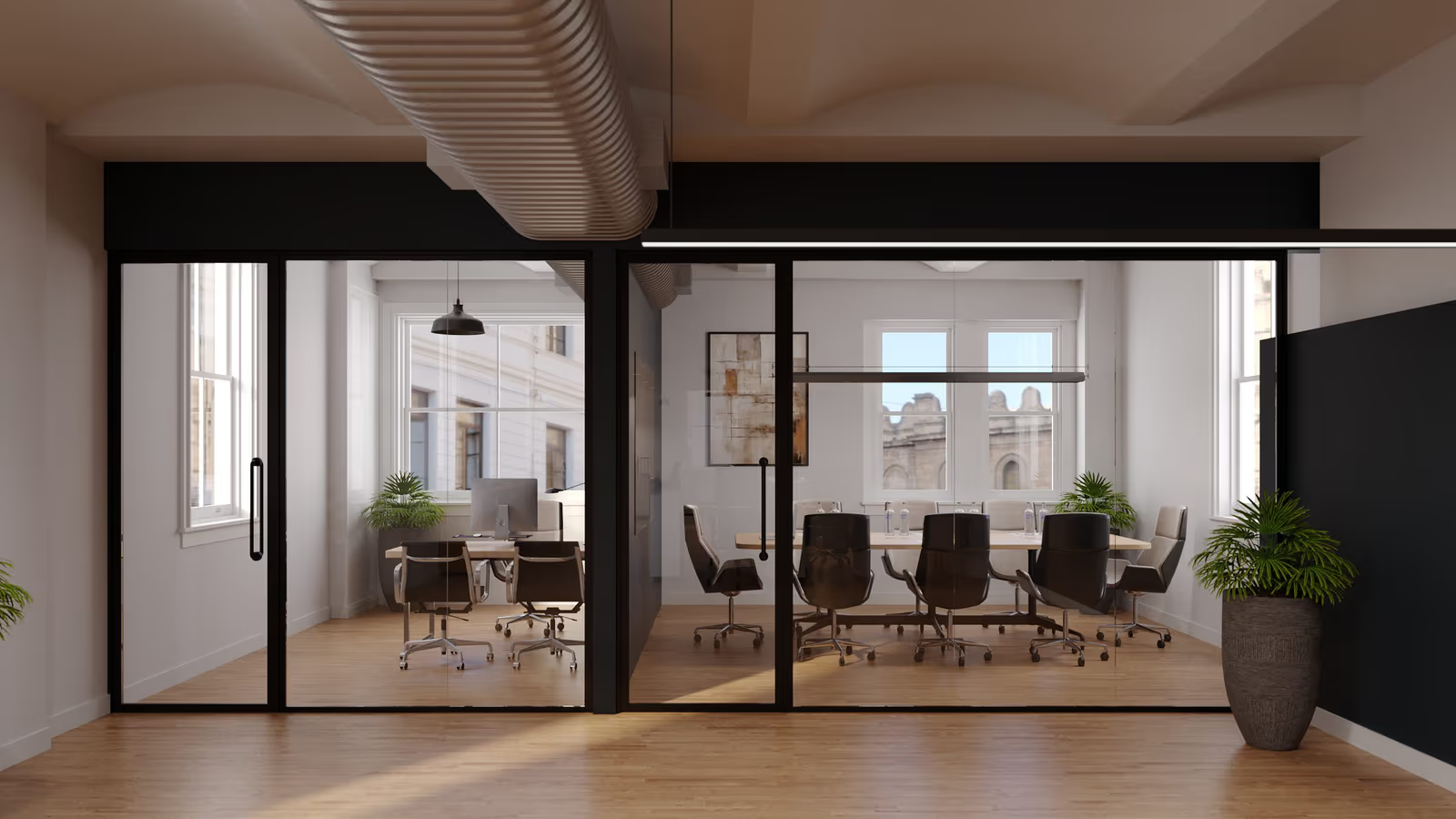
The sequence matters more than any single decision: US entity and bank account first, because the letter of credit needs both; broker and search second, because touring without the entity wastes the best options; design during lease negotiation rather than after signing, because the DOB clock only starts when drawings exist. Companies that run these in parallel open in a quarter; companies that run them in series discover each step was waiting on the previous one and lose a season. The other SF habit to drop: waiting for the perfect listing to appear online. In New York the best boutique floors trade before they are broadly marketed.
Translate the units before anything else
San Francisco quotes office rent monthly, per usable square foot, and New York quotes it annually, per rentable square foot, a measurement that folds in your pro-rata share of lobbies, corridors, and mechanical space that a usable figure never counted. The gap between the two conventions is larger than most teams expect. A New York floor asking $72 works out to $6.00 a month before you touch the measurement question at all, and once you adjust for a typical 20% loss factor the like-for-like figure lands near $7.50 per usable foot per month. That is still generally competitive with prime SoMa, but not by the margin the raw numbers imply, and a team that walks into its first tour believing New York is half the price of home will eventually overbid out of sheer relief.
Nearly every mispriced expectation we see from West Coast companies traces back to skipping that conversion. Do the arithmetic once, in writing, before the first tour, and circulate it to everyone on your side who holds signature authority. From that point forward the search prices normally, offers land at sensible levels, and nobody gets talked into a premium floor because it looked cheap by California math.
Where SF companies land, and why
The pattern across our placements is remarkably consistent. Engineering-led companies choose Flatiron and Union Square for the transit reach, design-led companies add SoHo to the tour for the address, and the pragmatists eventually discover Chelsea, where the discount is real and the commute is nearly identical. The corridor logic mirrors SoMa's, one connected district where the talent already commutes, with asking rents running $43 to $200 and a $75 median across our current book.
- Flatiron and Union Square carry the reach and the tech cluster, and they are the default first tour for a reason
- Chelsea holds 7 floors right now at $44 to $63, which makes it the value entry into the same corridor
- SoHo remains the brand floor, and the consumer companies that pay for it do so knowingly
New York also adds one variable a San Francisco search never had to weigh, which is commuter rail. If your future sales leadership lives in the suburbs, adjacency to Grand Central and Penn Plaza matters in a way BART proximity never did, and we have watched senior hires accept or decline offers on that single consideration. It deserves a line in the site-selection brief, not a shrug after signing.
Running a search from three time zones
The remote playbook that actually works is disciplined about which decisions happen where. Fix the brief from California, meaning headcount, budget band, and two target neighborhoods, then fly one decision-maker east for a single 48-hour tour of five or six floors and give that person genuine authority to shortlist on the spot. The 3D walkthroughs on this site exist for exactly this stage. Seven of our floors are fully scanned, and walking them online kills half the tour list before anyone boards a plane, which is the difference between a focused trip and a wasted one.
Everything after the tour runs remotely without much friction. Test-fits, engineer letters, and lease markup all move over email and calls, and the lawyers never need to share a conference room. Plan a quarter from kickoff to desks, roughly three weeks of search, four to six weeks of lease negotiation, and the balance in buildout. A second trip is only genuinely necessary when a custom buildout reaches design sign-off, and most of our West Coast clients handle everything up to that moment without leaving home.
Terms that read differently here
New York leases run longer by default, five to ten years against San Francisco's shorter norms, but term is a trading chip rather than a fixed condition, and shorter flexible structures exist across the market, ours included, when you negotiate for them deliberately. Free rent of about a month per lease-year is customary and should be assumed in any offer you model. The Good Guy Guarantee will be the strangest clause your San Francisco counsel has ever encountered, a personal guarantee that ends when you vacate properly with rent current. It is a New York peculiarity, it is standard, it is survivable, and it is worth reading our glossary page about before the first draft arrives, because counsel who fight it on principle burn negotiating capital that would be better spent on concessions.
The brokerage economics also differ, and pleasantly so from your side of the table. In New York the landlord pays the tenant broker's commission, so our representation costs you nothing directly, and because we only ever act for tenants there is no conflicted interest anywhere in the negotiation. Treat the published rents across this site as where our negotiation starts on your behalf, not where it ends.
The two-office operating pattern
The SF-plus-NYC shape settles into a predictable division of labor within the first year. New York takes go-to-market, the client-facing functions, and the East Coast engineering hires; the time offset gives the company a nine-hour customer day; and the founders discover fairly quickly which meetings genuinely need a coast and which never did. Plan the office for that division of labor rather than as a smaller copy of headquarters, which in practice means more client-facing polish and more meeting capacity per head than the San Francisco office carries, because hosting is the job the New York floor was opened to do.
Size it at 175 square feet a person against the eighteen-month New York headcount specifically, not against the company-wide growth model and not against HQ's density plan. Satellite offices that copy the mothership's ratios always run out of meeting rooms first, and a New York office that cannot host a client on short notice has failed at the one thing it exists for.
Mistakes SF companies make here, so you can skip them
We have watched enough second offices open to recognize these errors by their first symptoms, so here they are in roughly the order they tend to appear.
- Comparing raw dollars per square foot across coasts without the rentable-versus-usable conversion, then overbidding out of relief when New York looks deceptively cheap
- Copying the San Francisco open-plan ratio into an office whose actual job is hosting clients, and discovering the shortage of conference rooms only after move-in
- Ignoring commuter rail in the hiring plan, and losing suburban senior candidates that a smarter office placement could have won
- Signing short SF-length terms out of habit in a market that rewards trading term length for concessions
- Running the search from three time zones without virtual walkthroughs, when seven of our floors are fully scanned and touring them online costs nothing
None of these is expensive to avoid. Each one yields to a modest amount of local structure around the search, which is, in the end, the practical case for tenant-side representation on this coast rather than an argument about principle.
How is NYC office rent quoted differently from San Francisco?
San Francisco quotes monthly, often per usable square foot. New York quotes annually, per rentable square foot, which includes a share of lobbies, corridors and mechanical space. A 5,000 sq ft space at $75 is $375,000 a year, about $31,250 monthly, and the usable area is typically 15–25% smaller than the rentable figure. Comparing an SF number to a NYC number without converting both is the single most common error.
What is a letter of credit and why does New York want one?
Instead of a cash security deposit, NYC landlords generally require an irrevocable letter of credit from your bank, commonly three to twelve months of rent depending on covenant strength. For a venture-backed company without profitability, expect the higher end. It ties up balance sheet, so it belongs in the plan from day one, not discovered at lease signing.
How long does it take to open a New York office?
Two to four weeks for a furnished pre-built floor. Ten to sixteen weeks if you build out: two to three weeks design, three to four permits and long-lead items, six to nine construction. Filing with the Department of Buildings has no direct SF analogue and is where most first-time NYC timelines slip.
Where do San Francisco companies usually land in New York?
Midtown South, Flatiron, NoMad, SoHo, Chelsea and Union Square. It is the closest analogue to SoMa: loft floor plates, dense tech presence, and transit that reaches the neighborhoods engineers live in. Nomad currently has 31 spaces across those submarkets.
Do you need a New York broker if you already have one in SF?
Yes, practically speaking. Submarket knowledge does not transfer: which landlords move on free rent, which buildings have real power capacity, which floors have been sitting. Tenant-representation commissions are paid by the landlord in New York, so a local tenant-only broker costs the tenant nothing directly.
What surprises SF companies most?
Lease length. Where San Francisco tolerates three-year deals routinely, New York landlords price five to ten years as standard and charge for anything shorter. Shorter structures exist, subleases, pre-builts, 12 to 36-month direct deals, but they must be sought deliberately.
Matching space available now
-
 153 W 27th Street [Partial 3rd Floor] 2,978 sq ft $44/sq ft Chelsea
 -
 6 Greene Street [Entire 2nd Floor] 4,900 sq ft $78/sq ft SoHo
 -
 30 West 21st Street [Penthouse floor] 5,250 sq ft $115/sq ft Flatiron
 -
 276 Fifth Avenue [9th Floor] 5,500 sq ft $52/sq ft Flatiron
 -
 50 Greene Street [3rd Floor] 7,300 sq ft $98/sq ft SoHo
 -
 137 East 25th Street [6th Floor] 8,308 sq ft $43/sq ft Flatiron
The team
The people you'll actually deal with
Tenant-side brokers, builders and operators, 300+ New York offices delivered between them.
Meet the whole team → Matthew DeRose
 Megan Gallagher
 Nicholas Hein
 Adam Justin
 David Greene
Talk to a broker
Availability moves daily, get today's version
The spaces above are current as of this week. Tell us team size and timing and a broker sends today's live list for this exact search, with all-in monthly costs, and anything new that has not been published yet.
- Same daya broker replies personally, no automated triage
- Tenant-onlyNomad never represents the landlord
- Open pricingrent and size published before you talk to anyone
- 300+ officesdelivered across 2M+ sq ft in New York
Or call 646-688-3158