From Series A to Series B: Planning an NYC Office That Will Not Constrain Growth
A Series A team is typically 15–30 people and will be 40–80 by Series B. Space taken for the Series A headcount will be wrong within a year. The workable approach is to size for the midpoint, about 7,875 sq ft for a team heading to 45, take a term that matches your forecasting horizon rather than the landlord's preference, and negotiate expansion rights on contiguous space so growth does not mean moving. At the $75 median that is roughly $49,219 a month.
Updated 2026-09-30 · Sizing for the next round · Nomad Group
 William JanetschekCo-Founder, COO · Nomad Group
Structure for the scenario you don't want. The test of a Series A lease is not what it costs if the round lands; it is what it costs to unwind if it doesn't. Three clauses set that price: the notice period on the good guy guarantee, the consent standard on subletting, and the restoration scope at exit. If those three are clean, taking the larger floor is a calculated position rather than a gamble. Founders negotiate rent hardest, but the exit terms are where the real risk lives, and where landlords concede most readily.
The stage where the office starts mattering
Between the A and the B, headcount typically runs from 15 to 60 people, hiring accelerates past whatever the office was chosen for, and the space itself changes jobs. It stops being a place to sit and becomes evidence. Candidates read it as proof the company is real before they sign, the board reads it as proof that spend is under control, and the team reads it as the physical shape of the next year. The failure modes sit at opposite ends of the same mistake: we have watched a showpiece lease eat eighteen months of runway, and we have watched a cramped sublease cost a client three senior hires who toured the office and quietly took the other offer.
The corridor arithmetic frames the decision before anyone books a tour. At the $75 median, each ten people cost about $10,900 a month at standard density, so a 30-person company should be reasoning about $32,800 a month plus operating costs, held up against whatever its coworking invoice already reads. That comparison lands closer than most founders expect, and in our experience it tips toward a direct lease earlier than they assume.
Size for the plan you actually believe
Take the eighteen-month headcount from the model your board actually saw, not the stretch case that gets traded over drinks, and multiply it by 175 square feet a person. A company hiring from 30 to 65 should be touring 10,000 to 12,000 square feet, or taking 7,000 with a genuinely bound expansion right, meaning a right of first offer on the adjacent floor written into the lease, or a term short enough that the whole question can be re-decided in two years without penalty. The multiplication is easy. The discipline is in which headcount number you feed into it.
- A 25-person team with 45 in the plan should tour around 8,000 sq ft and resist talking itself into less.
- A 40-person team with 70 planned should tour 12,000 and interrogate the stacking options before committing to a single floor.
- A team whose plan is genuinely unforecastable should pay for flexibility explicitly, through a shorter term or a flex structure, rather than implicitly through empty desks nobody budgeted for.
What boards actually ask, and the answers
Expect three questions, usually in this order. The first is total obligation, which is term times annual cost and is the number that goes in the minutes; at $75 on 8,000 feet, a five-year lease is a $3.0M commitment, and a board that hears only the monthly figure will do that multiplication in the meeting and wonder what else got rounded. The second is downside protection, which in New York means sublet rights, assignment on acquisition, and the Good Guy structure that caps personal exposure. The third is comparables, which is exactly what this site's published rents exist for, since your board can verify the market themselves in five minutes without taking anyone's word for it.
The way to get a search approved in one session is to bring the answer sheet to the meeting rather than the meeting to the search. A one-page memo covering three floors, with real rents, the total obligation on each, and a recommendation, is the document boards say yes to, and we draft that memo as part of any engagement at this stage.
Sequencing against the raise
The rule we give clients is to sign after the wire clears and tour before it does. The search-to-desks pipeline runs about a quarter start to finish: three weeks of touring, a month of lease negotiation, and the remainder in buildout. A company that starts touring at term sheet therefore moves in roughly one quarter post-close, which is exactly when the hiring plan needs the desks. A company that waits for the money to land before starting spends its first funded quarter looking at floor plans instead of filling them.
Bear in mind that landlords read funding announcements too. A fresh raise strengthens your covenant story and weakens your urgency story in the same news cycle, and an enthusiastic founder touring the week after the announcement is negotiating against himself. This is one of the places we earn the fee. We carry the negotiation so the enthusiasm stays off the table, and the published asking rents remain the start of the conversation rather than the finish.
A stage-true example from the live book
Take a 25-person post-A company hiring to 45, which is close to the median client we see at this stage. The plan translates to about 8,000 square feet, and the comparison writes itself out of our current book. The 6th floor at 137 East 25th Street offers 8,308 feet at $43, which runs $29,800 a month with the growth already built into the walls. The tighter 6,100-foot 11th floor at 213 West 35th Street in Penn Plaza, at $52, runs $26,400 a month, with a first-offer right doing the stretching that the square footage does not. The total five-year obligation comes to $1.79M against $1.58M, and both positions are defensible in front of a board; they are simply shaped differently, one carrying space and the other carrying an option.
That one-paragraph comparison is the core of the board memo, and producing it took nothing more than published rents and ten minutes. The remaining work, the walkthroughs and the clause negotiation, is the part we carry, and it is where the two obligations stop being numbers on a page and become floors you can picture the team on.
Signals you are sizing it wrong
- The stretch case is driving the square footage while the base case is paying the rent, which leaves the company long space it can only justify if everything goes right.
- Desks are being planned for people whose offers have not gone out, let alone been accepted.
- The term runs longer than the runway plus one raise, so the lease outlives the money that is supposed to pay for it.
- Nobody has priced the sublet scenario, which is the honest hedge against a plan that is, statistically, wrong somewhere.
The A-to-B office should be the company's most reversible big commitment, not its least. Structure beats square footage every time the plan wobbles, and every plan we have seen at this stage wobbles somewhere.
What the B round changes, and what to pre-wire
The next round rewrites the office math all over again. Headcount doubles once more, the board adds seats that come with opinions about burn, and diligence now includes a lawyer actually reading your lease rather than skimming it. The time to prepare for that scrutiny is at the A-stage signing, not the week the data room opens. That means assignment language an acquirer or a new corporate entity can inherit cleanly, expansion rights that convert growth into adjacency rather than a second address, and total-obligation numbers your CFO can produce in one line, because someone across the table will ask for them.
When the B-stage move comes, it runs on evidence the A-stage floor generated. Real utilization, real conference room load, and real commute data from a bigger team replace the guesswork that sized the first office. Companies that logged that year move into space that fits; companies that skipped the logging repeat the same guesswork at 3x the rent. Twelve months of paying attention to how the office actually gets used is the cheapest space-planning consultancy that exists.
The relationship compounds too, if you let it. The broker who delivered the A-stage floor holds the usage history, the landlord relationships, and the renewal leverage by the time B-stage scale arrives, and that continuity is worth actual dollars at the second negotiation. It is why our engagements are built to span rounds rather than transactions, and why the client stories on this site are mostly second and third chapters rather than first ones.
How much space should a Series A company take?
Size to headcount 12–18 months out, not today. A 20-person team heading to 45 should be looking at roughly 7,875 sq ft rather than 3,500. Carrying surplus for a year is almost always cheaper than moving inside the term.
What if the round does not come?
This is the real argument for sublet rights and a shorter term, not for taking less space. A team that stalls can recover most of the cost by subletting surplus space; a team locked into an undersized floor for five years has no remedy at all.
What clauses matter most between rounds?
Expansion rights on contiguous space, a right of first offer on the floor above or below, sublet rights without unreasonable landlord consent, and an improvement allowance sized to the space you may eventually take. These are negotiated once, at the term sheet, or not at all.
Should you take surplus space and sublet it?
Often yes, if the building permits it and the surplus is a discrete area rather than scattered desks. It converts a fixed cost into a partly recoverable one, and gives you the floor when you need it without a move.
How does the buildout fit the funding cycle?
Buildout is a capital cost partly offset by a landlord allowance, and it lands right after signing, usually the tightest point in the cycle. Sequencing the lease shortly after a close, rather than shortly before, avoids paying for construction out of the runway you are trying to extend.
Matching space available now
-
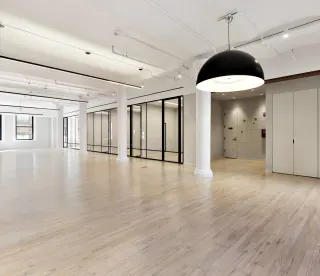 520 Broadway [Entire 10th Floor] 5,539 sq ft $125/sq ft SoHo
 -
 503-511 Broadway [Penthouse] 5,552 sq ft $125/sq ft SoHo
 -
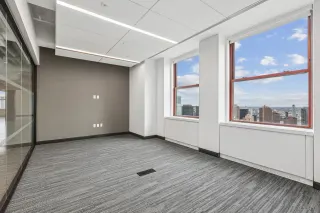 Empire State Building [Partial 43rd Floor] 5,621 sq ft $90/sq ft NoMad
 -
 60 East 42nd Street [Partial 13th Floor] 5,772 sq ft $72/sq ft Grand Central
 -
 22 West 27th Street [Entire 7th Floor] 6,000 sq ft $57/sq ft NoMad
 -
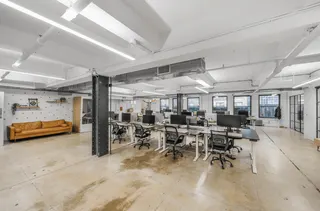 213 West 35th Street [11th Floor] 6,100 sq ft $52/sq ft Penn Plaza
The team
The people you'll actually deal with
Tenant-side brokers, builders and operators, 300+ New York offices delivered between them.
Meet the whole team → Matthew DeRose
 Megan Gallagher
 Nicholas Hein
 Adam Justin
 David Greene
Talk to a broker
Availability moves daily, get today's version
The spaces above are current as of this week. Tell us team size and timing and a broker sends today's live list for this exact search, with all-in monthly costs, and anything new that has not been published yet.
- Same daya broker replies personally, no automated triage
- Tenant-onlyNomad never represents the landlord
- Open pricingrent and size published before you talk to anyone
- 300+ officesdelivered across 2M+ sq ft in New York
Or call 646-688-3158