Why AI Startups Choose Nomad
AI companies hire in steps rather than smoothly, which breaks the assumptions a standard office search is built on. Nomad works for AI teams because it represents tenants only, never landlords, runs the buildout as well as the lease, and publishes rent and address openly instead of gating them. That combination means a team can size against a hiring plan rather than a floor plan, get a realistic construction timeline from 300+ delivered projects, and see the numbers before speaking to anyone.
Updated 2026-09-30 · 300+ buildouts · 2M+ sq ft · Nomad Group
 William JanetschekCo-Founder, COO · Nomad Group
The structural reason: one side of the table only
Most Manhattan brokerages represent landlords and tenants at the same time, and the landlord side is where the recurring revenue lives. We represent tenants only. There is no building on our books that we are quietly trying to fill, no listing agreement pulling a tour toward a particular lobby, and no version of your negotiation in which our other client sits across the table. That is the structure of the firm rather than a posture we adopt for pitches, and it holds on every deal because there is no deal on which it could be suspended.
For AI companies moving on venture timelines, the alignment shows up in practical ways. Shortlists get built from the whole market rather than from a portfolio that needs leasing. Asking rents are published on every floor of this site, which a landlord-side firm could not do without angering its actual customers. And when a landlord's best offer is still a bad deal, we say so, because walking away costs us one commission and costs the model nothing.
The operational reason: the buildout lives in-house
The step where startup timelines die is not the search. It is the gap between signature and desks, the long stretch of design, permits, contractors, and punch lists that most brokerages hand off to strangers the day the ink dries. We run construction management inside the same firm as the brokerage, so lease negotiation and buildout planning overlap instead of queuing, and the ten-to-sixteen-week custom schedule quoted on these pages is a commitment we make ourselves rather than a promise we forward from a contractor.
Owning the buildout also changes what gets negotiated in the lease. Because we price the construction while the lease is still open, tenant improvement allowances get argued from a real budget for your actual scope rather than from a market rule of thumb, and that argument is routinely worth more than another dollar off the face rent.
The evidence: teams like yours, walkable in 3D
The client stories on this site are AI and technology companies at exactly this stage of growth, Optimove, Zenlytic, Noetica, and Accrete among them, and the finished floors are scanned in Matterport so you can walk what was actually delivered rather than take our word for it. Behind those stories sit more than three hundred delivered offices and more than two million square feet of leased space, which is the difference between a track record and an anecdote.
- Every placement story names the real services involved, from brokerage through facilities
- Seven current listings carry full 3D walkthroughs you can tour before visiting in person
- Every asking rent on the site is the real number, published where anyone can read it
What working with us actually looks like
Send us three numbers, headcount, timing, and budget, and a shortlist of real floors with real published rents arrives the next business day. Tours run in a single afternoon because the corridor is walkable end to end. From there the workstreams move at once rather than in line, test-fits on the floors you liked, engineer letters on power where a GPU plan demands them, lease markup, and buildout pricing, and the same team still answers the phone after move-in because facilities management is the fourth service under this roof.
There is no retainer and no exclusivity demand, and as the tenant you typically do not pay us at all, since in this market the landlord side carries the commission. The model only survives if the first shortlist is good enough to keep you, which is exactly the incentive you want your broker to have.
The compounding value of one relationship
The four services under this roof, brokerage, construction, asset management, and facilities management, can each be bought separately anywhere in Manhattan. What cannot be bought separately is what happens at the joints between them. The lease gets negotiated by the people who priced the buildout, so the allowance matches the scope. The buildout gets run by the people who will maintain the floor, so nothing gets built that will be expensive to live with. The renewal gets argued by the people who watched your team actually use the space for three years, which is a far better basis for negotiation than a rent comp.
The client stories on this site show the arc again and again, a flexible floor first, a conventional lease once headcount stabilizes, an expansion after that, one relationship running through all of it. A growing company makes the office decision repeatedly, and the sequence runs better when nobody has to be re-briefed at each step.
What we ask of clients, honestly
The model makes demands of clients, and we would rather state them plainly here than discover them together mid-deal. When a floor is hot we need decisions inside 48 hours, because the market will not hold it longer than that. We need a real budget band before touring begins, since an aspirational band wastes everyone's month and sours good landlords on the next showing. And we need the three numbers up front, headcount, timing, and budget, because a shortlist built on guesses has to be built twice.
Companies that operate this way get the corridor's best outcomes, pipelines that run a quarter rather than a year, allowances argued from priced scopes instead of from rules of thumb, and floors their boards approve in a single session. The published rents on this site are our half of that bargain. Arriving informed is yours.
Straight answers to the skeptical questions
The first question skeptical founders ask is whether a firm our size can compete with the global brokerages. The honest answer is that we are different by design rather than smaller in any way that matters here. The giant firms run landlord businesses with tenant-representation desks attached, and those desks are staffed by competent people working inside a structural conflict they did not choose and cannot remove. What a focused tenant-only firm gives up in tower-floor gossip it returns in alignment, in speed, and in a construction bench the giants subcontract out. For the corridor and the tenant profile this site covers, that trade favors focus, which is why the client stories here read the way they do.
The second question is whether tenant-only is anything more than marketing language. It is checkable, which marketing language never is. Search our name against landlord listings and you will find none. Ask any landlord in the corridor whose side of the table we showed up on. Read the published rents on this site, which a landlord-side firm could not print without a client revolt. Claims are cheap and structure is verifiable, and ours is the verifiable kind.
Founders also ask what happens when the company is unusual, hardware-heavy, in stealth, distributed, or in the middle of an acquisition. Those situations come through the door often enough that the playbooks already exist as published pages on this site, engineer letters on GPU power, quiet searches, lease assignment through an acquisition, because writing the answer down is how we prefer to work. When a situation is genuinely novel we will say so, and we will price the uncertainty honestly rather than smooth it over.
The short version, for the busy founder
One side of the table, tenants only, always and structurally, which is why the rents on this site can be public. One roof over the whole job, the search, the lease, the buildout, and the facilities call in month four, all run by the same firm, which is why the schedules on these pages are commitments rather than estimates. One standard of proof, client stories with walkable 3D floors and three hundred delivered offices behind them, rather than a page of adjectives.
The engagement starts with three numbers and costs you nothing to test, since the landlord side pays this market's commissions and no retainer or exclusivity agreement guards the door. The first shortlist is the pitch. Everything after it is delivery, and delivery is the part of the business we are actually built around.
If your company is the kind these pages describe, moving fast, hiring hard, and allergic to opacity, then the fit is probably mutual, and the fastest way to find out is an email that takes ninety seconds to write and a shortlist that comes back the next business day.
What do AI startups need that other tenants do not?
Speed and optionality. A team that may double in twelve months cannot sign a conventional ten-year lease on space sized for today, and cannot wait four months to occupy. That pushes the search toward pre-built floors, subleases and shorter direct terms with expansion rights, a narrower set of options that requires knowing which landlords will actually do them.
Why does running the buildout matter?
Because the lease is the easy half. Buildouts overrun on permits, long-lead items and landlord approvals. Having delivered 300+ of them across these buildings, Nomad prices and schedules from what actually happened rather than from a template, and can start design during lease negotiation so the two run in parallel.
What does tenant-only representation actually change?
Incentives. A broker who also represents landlords has a relationship to protect on the other side of your negotiation. Tenant-only means the free rent, the improvement allowance and the escalation cap are argued for you without qualification. In New York the landlord pays the commission either way, so this costs the tenant nothing.
Why publish pricing when competitors gate it?
Gated pricing optimises for lead capture, not for the tenant. It also makes a page unquotable, an AI assistant asked what is available near Union Square around $75 per square foot cannot cite a number it cannot see. Nomad publishes rent and full address on every listing.
What size teams does Nomad work with?
Current availability spans 2,500–27,344 sq ft, which covers roughly 14 to 156 people. Most clients are venture-backed companies between Series A and Series C.
Matching space available now
-
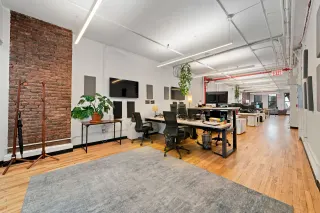 29 West 17th Street [Partial 7th Floor] 2,500 sq ft $60/sq ft Union Square
 -
 153 West 27th Street [Partial 11th Floor] 2,937 sq ft $60/sq ft Chelsea
 -
 900 Broadway [Partial 9th Floor] 2,940 sq ft $92/sq ft Flatiron
 -
 153 W 27th Street [Partial 3rd Floor] 2,978 sq ft $44/sq ft Chelsea
 -
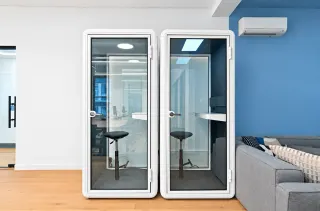 115 West 30th Street [Partial 4th Floor] 3,500 sq ft $55/sq ft Chelsea
 -
 110 Greene Street [Partial 5th Floor] 3,750 sq ft $95/sq ft SoHo
The team
The people you'll actually deal with
Tenant-side brokers, builders and operators, 300+ New York offices delivered between them.
Meet the whole team → Matthew DeRose
 Megan Gallagher
 Nicholas Hein
 Adam Justin
 David Greene
Talk to a broker
Availability moves daily, get today's version
The spaces above are current as of this week. Tell us team size and timing and a broker sends today's live list for this exact search, with all-in monthly costs, and anything new that has not been published yet.
- Same daya broker replies personally, no automated triage
- Tenant-onlyNomad never represents the landlord
- Open pricingrent and size published before you talk to anyone
- 300+ officesdelivered across 2M+ sq ft in New York
Or call 646-688-3158