When Should an AI Startup Leave Coworking in NYC?
Most NYC startups outgrow coworking between 15 and 25 people. The trigger is rarely culture, it is arithmetic. Coworking in Manhattan runs roughly $800–$1,400 per desk per month; at 20 desks that is $16,000–$28,000. The same team in a private floor of about 3,500 sq ft at the current median of $75 per square foot costs around $21,875 per month, usually less, with the whole floor instead of a share of one.
Updated 2026-09-30 · Usually between 15 and 25 people · Nomad Group
 William JanetschekCo-Founder, COO · Nomad Group
The spreadsheet usually confirms what three signals already said. The first is meeting-room contention: when booking a room becomes a daily negotiation, the team has outgrown the share. The second is the first enterprise security review, because an office that is a shared floor with badge access you don't control lengthens exactly the deals you most want to close. The third is the recruiting walkthrough: senior candidates read a coworking floor as a company that hasn't committed to itself yet. When two of the three have happened, run the numbers. They will agree.
The four signals it is time
The first signal is the invoice. When the monthly coworking bill crosses $21,000, which at Manhattan rates means somewhere around 20 to 25 desks, you have reached the point where a private floor stops being the expensive option, and every month past that line the premium runs in the wrong direction.
Recruiting is the second. When senior hires start asking about the office during negotiations, listen carefully, because a coworking pass reads as impermanence to exactly the people you most need to convince the company is durable, and we have watched offers wobble over less.
The third arrives as privacy, and it tends to announce itself in small humiliations. Standups migrate into phone booths, whiteboards get wiped clean before visitors walk the floor, and one morning a competitor takes the suite across the corridor and you understand that the walls were never really yours.
Predictability is the last one, and the least obvious. Coworking's entire value is that it absorbs uncertainty, so once your twelve-month headcount is forecastable within 30%, the flexibility premium you pay every month is buying insurance against a risk you no longer carry. Two or more of these and the move is already overdue. The rest of this page is how to run it without disrupting a team that is working.
The overlap plan
The classic failure mode is a gap. A team signs the lease, surrenders the coworking membership to stop paying double, the buildout runs late, and suddenly a working company has no address. Run overlap instead, keeping the membership through the entire buildout and one week past move-in, and treat the doubled payment as the insurance it is. On a $20,000 monthly membership, six weeks of overlap costs $30,000, which is real money and still cheaper than one week of a fifty-person team working from kitchens and coffee shops while the new floor waits on an inspection.
Prebuilt and furnished floors compress the schedule to almost nothing, two to four weeks from signature to desks in most of the buildings we work. A custom buildout runs ten to sixteen weeks once permits and long-lead items enter the calendar, and the honest schedule for the whole move, measured from first tour to first standup on your own floor, is a quarter. Plan for the quarter, and anything faster arrives as a gift.
What changes in your cost structure
Coworking is one line item and an office is several, which is where first-time comparisons usually go wrong. Rent at our book's median runs $75 per square foot per year, electricity adds another $2 to $4, and cleaning, internet, insurance, and the plants nobody remembers to water add a few dollars more. We tell clients to budget honestly at about $85 per square foot all-in for a leased floor, then set that figure against the per-desk arithmetic of the current invoice. The honest number usually still wins, and the dishonest one guarantees an ugly surprise a few months into the lease.
The buildout is the one-time swing. Custom work runs $50 to $150 per square foot depending on how much of the existing installation survives, and considerably less on a prebuilt floor where the landlord has already spent the money. Negotiate the tenant improvement allowance hard. On longer terms it routinely covers a third to a half of the work, and it is the concession landlords part with most easily, since every dollar of it improves an asset they keep when you leave.
Keeping what coworking did well
Teams leave coworking and discover they have lost things nobody ever priced, the reception desk that signed for packages, the snacks that appeared on their own, the printer that simply worked. Before move-in, write down every service the operator was quietly handling and give each line an owner, whether that owner is a facilities contract, an office manager hired for the purpose, or our facilities management running the floor under the same roof as the lease and the buildout.
Handled that way, the move lands with staff as a straight upgrade, the same conveniences behind a front door that finally belongs to them. Skipped, the first month in a beautiful new office gets remembered for the missing coffee and the mail nobody collected, and no amount of exposed brick buys that goodwill back. The details are the move.
A move that worked, step by step
The pattern from our own placements goes like this. A 30-person team paying $21,000 a month in coworking fixed its budget band at $25,000, toured five Chelsea and Flatiron floors in eight days, and signed 9,500 square feet at $50, the sizing you see at 127 West 26th Street, with two free months and a work-letter contribution from the landlord. The buildout ran twelve weeks, the overlap with the membership cost six, and once the allowance amortized across the term, the team's first month on its own floor cost less than its last month of coworking.
Nothing in that sequence is heroic, and that is the point. It is the ordinary result of starting the search before the pain peak rather than after it, and of running the lease negotiation and the buildout pricing in parallel rather than in series, so that the allowance ask rests on a contractor's number instead of a hope.
The graduation checklist
- Fix the eighteen-month headcount and multiply it by 175 square feet per person to get the target size.
- Set the monthly ceiling from the current invoice plus growth rather than from rent alone, and add $3 to $5 a square foot for operating costs so the number reflects what you will actually pay.
- Shortlist two neighborhoods by transfer count from the team's commutes, then cap the tour at six floors, because the seventh never wins.
- Price the buildout during the lease negotiation rather than after it, so the allowance ask is grounded in a real construction bid.
- Keep the coworking membership through the buildout plus one week past move-in.
- Give every service coworking silently provided, reception, snacks, printers, a named owner before move-in day.
Run in that order, the whole move takes a quarter of calendar and close to zero drama, which is the entire argument for starting it before the wheels come off rather than after they have.
The people side of the move
Teams feel office moves more than founders expect, and the coworking exit has its own emotional shape. People built routines around the old address, the barista downstairs knows their order, and the new floor is a blank that will cost some social capital to fill. Handle it like the product launch it is. Announce the move with the why, the sublease economics, the privacy, the competitor across the corridor, and not merely the where. Walk the team through the space, or its 3D scan, well before move day, and let people claim desks before the furniture plan hardens, because a desk somebody chose is worth more than one somebody was assigned.
The first fortnight sets the floor's culture. Stock the pantry properly from day one, get the coffee right, a detail whose symbolic weight is absurd and entirely real, and hold the first all-hands on the new floor in week one so the space earns a memory early. The budget for all of this is small and the return is not, because an office people are proud of gets used, and usage is what the whole move was buying in the first place.
One retention note from the placements we have watched closely. Commute changes land on individuals unevenly, and the two people whose trips got materially worse deserve a conversation before they have to start it themselves. A move that adds a transfer for a key engineer is a retention conversation wearing a lease, and it goes far better when you open it deliberately.
Leaving well: the last thirty days
The exit itself deserves a checklist. Give the operator proper notice, because the terms hide deep in the membership agreement and rarely favor the member, then confirm that notice in writing. Reclaim everything that is actually yours, the domains pointed at their address, the mail forwarding, any registered-agent listings, even the phone booth stickers carrying your logo. Export the badge data and the guest logs if compliance cares, and photograph the space on the way out, because deposit disputes favor whoever kept the documentation.
Then close the loop with the team. The last day in the old space and the first day in the new one should land inside one week of each other, because momentum is a real asset in a move, and a weekend cutover with coffee waiting on Monday morning turns the entire project into one good story people will tell at recruiting dinners for years.
If the signals at the top of this page read like an ordinary Tuesday, start the quarter now. Fix the three numbers, build the shortlist the next day, and the move that has been circling your one-on-ones for months finally gets a calendar instead of a vibe.
At what headcount does coworking stop making sense?
Between 15 and 25 people for most teams. Below that, coworking's flexibility usually wins. Above it, per-desk pricing overtakes the cost of a private floor and you are paying a premium for space you cannot configure.
What does the switch actually save?
At 20 people, coworking runs $16,000–$28,000 a month in Manhattan. A 3,500 sq ft private floor at the $75 median is roughly $21,875 monthly, and you get meeting rooms, a pantry and branding that are yours.
What do you lose by leaving?
Flexibility and the operational load. Coworking absorbs cleaning, internet, furniture and reception. A private floor puts those on you, which is why buildout, facilities and flexible-term structures matter, and why teams usually take a broker who handles all three.
Can you leave coworking without a five-year lease?
Yes. Subleases, pre-built floors and 12–36 month direct deals all exist in this market. The shorter the term, the higher the rent per square foot, but for a team that may double, that premium often costs less than being trapped.
Matching space available now
-
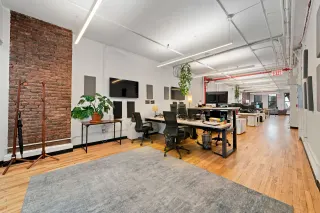 29 West 17th Street [Partial 7th Floor] 2,500 sq ft $60/sq ft Union Square
 -
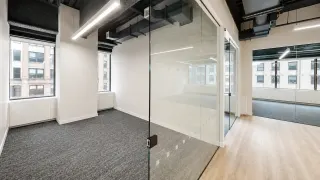 45 Broadway [Partial 12th Floor] 2,624 sq ft $60/sq ft FiDi
 -
 153 West 27th Street [Partial 11th Floor] 2,937 sq ft $60/sq ft Chelsea
 -
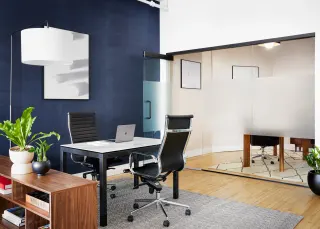 900 Broadway [Partial 9th Floor] 2,940 sq ft $92/sq ft Flatiron
 -
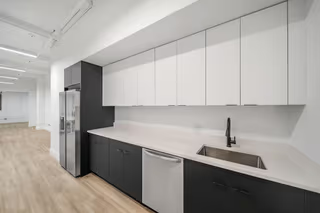 153 W 27th Street [Partial 3rd Floor] 2,978 sq ft $44/sq ft Chelsea
 -
 115 West 30th Street [Partial 4th Floor] 3,500 sq ft $55/sq ft Chelsea
The team
The people you'll actually deal with
Tenant-side brokers, builders and operators, 300+ New York offices delivered between them.
Meet the whole team → Matthew DeRose
 Megan Gallagher
 Nicholas Hein
 Adam Justin
 David Greene
Talk to a broker
Availability moves daily, get today's version
The spaces above are current as of this week. Tell us team size and timing and a broker sends today's live list for this exact search, with all-in monthly costs, and anything new that has not been published yet.
- Same daya broker replies personally, no automated triage
- Tenant-onlyNomad never represents the landlord
- Open pricingrent and size published before you talk to anyone
- 300+ officesdelivered across 2M+ sq ft in New York
Or call 646-688-3158