How Does a Flexible Office Lease Compare With Coworking?
Coworking charges per desk and bundles everything; a flexible lease charges per square foot and leaves operations to you. In Manhattan, coworking runs roughly $800–$1,400 per desk per month, so 20 desks costs $16,000–$28,000. A 3,500 sq ft private floor at the $75 median runs about $21,875 monthly. Below roughly 15 desks coworking usually wins on total cost; above 20 the flexible lease wins, and you gain a space you can configure and brand.
Updated 2026-09-30 · Break-even around 15–20 desks · Nomad Group
 William JanetschekCo-Founder, COO · Nomad Group
What each product actually is
Coworking sells memberships to a building someone else runs. You pay month to month or annually, the furniture and internet come with the badge, and your company is one logo among many on a floor whose rules the operator writes. A flexible office lease, the product we run as Flex by Nomad, is a real lease on a private floor with the term shortened and the services arranged for you. You get your own door, your name in the elevator bank, and an agreement measured in single years rather than the market's standard five to ten, with the obligations of a tenancy attached because it is one.
The confusion between the two products is profitable for coworking operators, because at the sizes where they genuinely overlap, roughly 15 to 60 desks, the flexible lease is usually the better deal while the coworking floor is the better-marketed one. Most of the teams who bring us this comparison have never had anyone price the lease side properly, and once both columns sit on the same page the decision tends to make itself.
The arithmetic at real sizes
Manhattan coworking prices for open and small-office setups cluster between $800 and $1,400 per desk per month, and $1,000 is a fair working number for decent stock. Thirty desks at that rate is $30,000 a month, every month, with nothing accruing to you underneath it. The same thirty people on a leased 5,250-square-foot floor at our book's $75 median pay about $32,800 in rent before you subtract whatever the landlord contributes to the fit-out, and you then carry roughly $3 to $5 per square foot per year in operating costs that the coworking invoice used to hide inside the desk rate.
- At 15 people, coworking usually wins on pure cost and carries zero commitment
- Between 25 and 40, the lines cross; a flexible lease matches coworking within the noise and buys you privacy
- At 50 and up, the lease wins outright, often by six figures a year
The crossover arrives earlier than most founders expect, because coworking pricing scales linearly with heads while a lease scales with area, and the area each person needs falls as a team grows into shared rooms and conference space that no longer sits idle. A team of forty is not paying for forty desks' worth of floor; it is paying for one efficient floor. The desk rate never falls as you grow, but the effective rent per person on a lease does.
What the spreadsheet misses
Some of what a private floor buys never shows up in the per-desk comparison. Your roadmap stays on a whiteboard nobody else walks past, and your candidates stop sharing an elevator with a competitor's recruiter. Senior hires read a private floor as evidence of permanence, and in our experience they say so in negotiations more often than founders realize. Control matters as well, in ways that compound quietly over a lease term. The access policy is yours, the security posture is yours, and whether Fridays are in-office is your decision rather than a clause buried in an operator's community rules. None of that appears in a per-desk quote, and all of it shows up in recruiting and retention inside a year.
Coworking's genuine advantages deserve the same honesty. The speed is measured in days, the capital outlay is zero, and shrinking is as simple as declining to renew. For a company that cannot forecast two quarters ahead, those are worth paying real money for, and we tell clients so. The mistake we see is paying for them out of habit, long after the forecast has stabilized and the flexibility premium has quietly become pure cost.
The middle path, named
Flex by Nomad exists for the crossover zone. It puts a 25-to-50-person company on a private floor at a shorter term with the services arranged, which is to say lease economics without lease rigidity. Several of the client stories on this site began exactly this way, a flexible arrangement first and a conventional lease later on the same relationship, because the first deal proved the second one out and the team never had to move twice to get there.
If you are inside that zone now, send us the three numbers that drive the whole analysis, headcount, timing, and budget, and we will price both paths against live floors from our book so the comparison is real rather than theoretical. It takes us a day, it costs you nothing, and it replaces a quarter of internal debate with a page of figures.
A worked crossover, with real numbers
Take a 28-person team paying $28,000 a month for coworking at $1,000 a desk. The leased equivalent is about 4,900 square feet, and 6 Greene Street's second floor happens to be exactly this size, so the comparison can run against a real door rather than an average. At its $78 SoHo ask the floor costs $31,850 a month, while priced at a Chelsea-value $59 equivalent it comes to about $24,100. Add operating costs of roughly $1,500 a month, subtract the landlord-funded slice of the fit-out, and you are looking at the honest lease-side number for the first time.
At corridor-median pricing the two paths converge within the noise, and the lease side is buying privacy, brand and economics that improve with every hire. At thirty-five people the lease wins by five figures annually. At fifteen, coworking's reversibility still earns its keep. The crossover is a number you can compute, not a philosophy you have to adopt, and it moves in the lease's favor with every offer letter you send.
Questions that settle it in one meeting
- Can you forecast headcount eighteen months out to within 30%? If not, stay flexible; if you can, keep reading
- Is the monthly coworking invoice past $15,000? That is roughly the arithmetic crossover at Manhattan pricing
- Have senior candidates asked about the office during negotiations? If so, permanence is already being priced into your offers
- Do clients, press, or investors walk through your space? Then privacy and brand have started paying rent whether you invoice for them or not
Two or more yeses and the flexible-lease comparison deserves a priced look rather than another quarter on the someday list. That look is one email with the three numbers to us, and a real floor-by-floor answer comes back the next business day.
The operator economics, so the pitch makes sense
Understanding why coworking costs what it costs makes the whole comparison cleaner. An operator leases floors at market rent, builds them out densely, and resells the space per seat with services and a margin layered on top, so your $700 desk is covering their rent, their buildout amortization, their staff, and their return all at once. None of that is sinister. It is a real service with real costs behind it, but it also means the per-seat price structurally cannot beat a direct lease once a team is dense enough to use a floor efficiently on its own.
The operator's genuine edge is utilization risk. They absorb the empty-desk problem across many customers at once, which is precisely the risk a small or unforecastable team is paying to shed. The moment your own utilization becomes predictable, you are paying an insurance premium against a risk you no longer carry, and the flexible lease, meaning a private floor on a shorter term with services arranged at cost rather than at margin, captures that difference for you instead of for the operator.
That is the economics of the decision in a sentence. Coworking sells you insurance and a lease sells you the asset, and the right purchase depends on which risk you actually hold this year. Price both against your real forecast, not against the operator's brochure, and for that matter not against ours either.
Deciding this week, not this quarter
The comparison on this page runs in one sitting. Put the current coworking invoice on one side. On the other, put the calculator's output for your headcount at the live median, add $3 to $5 a foot in operating costs, and subtract a plausible landlord allowance. If the lease side wins by more than 10%, the move pays for its own friction and the search should start now, because the pipeline from first tour to keys takes a quarter and every month of delay is the delta, spent.
If coworking still wins, book the re-check rather than shelving the question. The crossover creeps closer with every hire, and the companies that time the switch well are simply the ones that ran the numbers quarterly instead of annually and moved the month the answer flipped. We keep the medians on this site live for exactly that reason, so the re-run takes minutes rather than another engagement.
Either way the verdict lands, the flexible middle exists for the case where the forecast is soft but the privacy need is hard, a private floor on shorter terms, priced on request against your actual numbers. One email carrying three figures, and the comparison this article describes comes back to you as a spreadsheet with your name on it.
Which is cheaper, coworking or a flexible lease?
Below about 15 desks, coworking. Above about 20, a flexible lease, at 20 desks the comparison is $16,000–$28,000 against roughly $21,875 for 3,500 sq ft of your own.
What do you give up on a flexible lease?
The bundled operations. Coworking includes cleaning, internet, furniture, reception and coffee. On your own floor those become line items and someone's job, the reason facilities management usually gets bought alongside.
How short can a flexible lease be?
Twelve months is achievable in this market, with 24 and 36 more common. Shorter terms carry higher rent per square foot and smaller buildout allowances.
Can you get furnished space on a flexible term?
Yes, pre-built and furnished floors combine the speed of coworking with the control of your own space, and are usually the right answer for a team leaving coworking for the first time.
Matching space available now
-
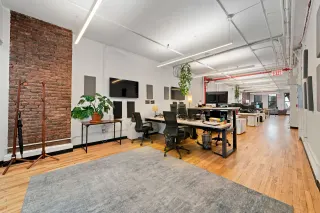 29 West 17th Street [Partial 7th Floor] 2,500 sq ft $60/sq ft Union Square
 -
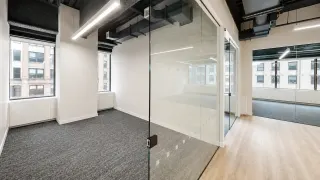 45 Broadway [Partial 12th Floor] 2,624 sq ft $60/sq ft FiDi
 -
 153 West 27th Street [Partial 11th Floor] 2,937 sq ft $60/sq ft Chelsea
 -
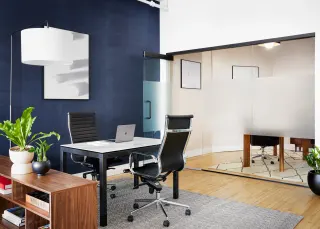 900 Broadway [Partial 9th Floor] 2,940 sq ft $92/sq ft Flatiron
 -
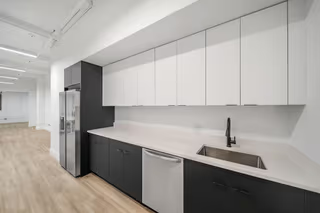 153 W 27th Street [Partial 3rd Floor] 2,978 sq ft $44/sq ft Chelsea
 -
 115 West 30th Street [Partial 4th Floor] 3,500 sq ft $55/sq ft Chelsea
The team
The people you'll actually deal with
Tenant-side brokers, builders and operators, 300+ New York offices delivered between them.
Meet the whole team → Matthew DeRose
 Megan Gallagher
 Nicholas Hein
 Adam Justin
 David Greene
Talk to a broker
Availability moves daily, get today's version
The spaces above are current as of this week. Tell us team size and timing and a broker sends today's live list for this exact search, with all-in monthly costs, and anything new that has not been published yet.
- Same daya broker replies personally, no automated triage
- Tenant-onlyNomad never represents the landlord
- Open pricingrent and size published before you talk to anyone
- 300+ officesdelivered across 2M+ sq ft in New York
Or call 646-688-3158