Coworking, Sublease, or a Private HQ? How Growing Startups Should Choose
Coworking suits teams under about 15, where per-desk pricing beats the cost and operational load of a private floor. Subleases suit teams of 15–60 that want a built-out space quickly on a shorter term, usually below direct asking rent. A private headquarters suits teams above roughly 25 that need to configure and brand the space, and can commit to a term. At 20 desks the comparison is stark: $16,000–$28,000 a month in coworking against roughly $21,875 for 3,500 sq ft of your own floor.
Updated 2026-09-30 · Three routes compared · Nomad Group
 William JanetschekCo-Founder, COO · Nomad Group
The three variables that actually decide it
Strip away the marketing and three variables decide this question. The first is how far ahead you can forecast headcount with any honesty. The second is how much privacy is actually worth to your work, whether that means client meetings, security reviews, or simply conversations that should not happen within earshot of a stranger's standing desk. The third is the monthly all-in number your finance model can carry without flinching. Coworking maximizes reversibility, a private lease maximizes control and unit economics, and a sublease sits between them, cheaper than either at its best but bounded on every side by someone else's lease.
In the sections below we price each path at the sizes where companies actually face the choice, using the live numbers from our own book, which currently mean a $75 median rent across our floors and coworking running around $700 a desk in the neighborhoods we cover.
What coworking really sells
Twenty desks at $700 comes to $14,000 a month with everything included, and the membership can usually be wound down in a matter of months rather than years. That reversibility is worth real money to a company that cannot see two quarters ahead, and nothing else in the market matches the speed, since a decision made on Monday can have the whole team at desks by Friday.
The costs sit on the flip side of the same features. Per-desk pricing scales linearly, which gets brutal past 25 heads. The space carries no identity of yours, which matters more than founders expect once they start recruiting senior people who have worked in good offices. And privacy depends on phone-booth availability at ten in the morning. When the invoice crosses $15,000, or a competitor signs into the same floor, the arithmetic and the instinct tend to reach the same conclusion within a week of each other.
The sublease discount and its fine print
Subleases run 10 to 25% under direct asking rents, arrive furnished more often than not, and carry shorter terms, genuine bargains created by someone else's change of plan. The catches live in the paperwork rather than in the space itself. Your rights are capped by the head lease, alterations need two consents instead of one, and if the sublandlord defaults on its own obligations, your tenancy inherits the mess along with the furniture.
- Best for: 12-to-36-month horizons, and teams that can take space as-found
- Watch: consent timelines, restoration duties, and whether the head landlord will recognize your tenancy
Our sublease playbook page walks through the diligence list in full, but the short version is worth stating plainly. A good sublease is the market's best-kept discount, and a bad one is litigation with desks in it.
Pricing the private floor honestly
A 30-person floor at 5,250 square feet and the $75 median runs about $32,813 a month, plus $3 to $5 a foot in operating costs, before a buildout that the landlord's allowance should partly fund if the deal is negotiated properly. Set that against $21,000 of coworking for the same heads and the premium runs about $11,813 a month, which is real money, but what it buys compounds over the term. Your own door, your own security posture, a culture that lives somewhere physical, and economics that improve as you grow instead of deteriorating with every hire.
The rule we give companies is straightforward. If headcount is forecastable to 18 months and past 25 heads, go private. If it is unforecastable or under 15, stay flexible. In between, price a flex floor and a sublease against each other and let the specific deals decide, because at that size the right answer lives in the terms rather than in the theory. Send us the three numbers and we will run exactly that comparison against live floors.
Three companies, three right answers
The nine-person model-research team stayed in coworking for another year, and rightly so, because its headcount was unforecastable, nobody ever visited the office, and every spare dollar was needed for compute. The 22-person fintech took a furnished sublease with eighteen months of runway to a Series B, accepted the space as-found, and locked in an effective rent 20% under direct asks. The 45-person platform company signed the private floor for five years, negotiated a real allowance, and got its own door in time for the security review its enterprise customers kept asking about.
Same market, same month, three correct calls, and they diverged only because the variables did. One team could not forecast, one valued the discount over the fit-out, and one needed the privacy badly enough to pay for permanence. The framework never gets more complicated than those three questions applied honestly to your own situation.
The switching costs nobody prices
The paths are not free to move between, and the switching costs deserve a line in the model before you choose. Moving from coworking to a lease costs a buildout and a quarter of calendar. Moving from a sublease to a direct lease costs a second relocation at exactly the moment the company least wants one. An oversized private floor costs empty-desk rent that no clause in the lease will ever refund. Whichever path you choose, choose the exit at the same time, which means understanding the notice periods, the restoration duties, what the furniture will be worth on the way out, and who keeps the fiber contract when you go.
Pricing the exit is most of what a tenant-side broker adds at this particular decision. We have watched every version of the switch play out across our client base, and the cheap-looking option with the expensive exit remains the oldest trap in this market.
Hybrid patterns that actually work
The three paths mix better than the framing suggests, and for a company between clean stages the mix is often the right answer. The hub-and-membership pattern puts a private floor under the core team and a handful of coworking passes in the hands of remote staff who visit monthly, which keeps the lease honestly sized and the visitors covered. The sublease-bridge pattern buys eighteen furnished months while the company proves its New York thesis, then converts to a conventional lease sized by real attendance data rather than by optimism. The landlord-flex pattern, which we run as our Flex model, pairs a direct lease with a shorter term and services arranged, and it fits the company whose forecast is soft but whose privacy need is hard.
What separates a working mix from a drifting one is a named decision point, meaning the date, metric, or event that collapses the arrangement back to a single path. A mix without a decision point quietly becomes permanent, and permanently paying two kinds of overhead is the worst of both sets of economics.
The practical discipline is to price the mix as a portfolio, taking the total monthly cost across every commitment and setting it against the single-path alternatives, then re-running the comparison every two quarters. The numbers on this site keep the lease side of that arithmetic live, your membership invoices keep the other side honest, and a decision reviewed on that schedule stays a decision instead of hardening into a habit.
Whichever path you take, decide it on paper
The framework's whole value is that it ends the debate. Three variables, three paths, one spreadsheet, and the office question goes back to being an operational matter instead of an emotional one that resurfaces at every leadership meeting. Write the decision down while you make it, including the horizon you assumed, the ceiling you set, and the weight you gave privacy, so that when circumstances shift you find yourselves revisiting assumptions rather than relitigating taste.
Every input the comparison needs is already live on this site. The calculator handles the per-seat lease arithmetic, the availability page shows real floors with printed rents, and the sublease flow rides along automatically once we know your brief. The membership side of the ledger is sitting on your last coworking invoice.
One email with three numbers turns the general framework into your version of it. We price all three paths against the live market, and the decision that has been circling your leadership meetings for a quarter lands in a single sitting, on evidence.
When does coworking stop making sense?
Between 15 and 25 people for most teams. Below that its flexibility and bundled operations genuinely win. Above it, per-desk pricing exceeds the cost of a private floor and you are paying a premium for space you cannot configure.
What is the case for a sublease?
Speed and price. The space is already built, so occupancy is weeks rather than months; terms are short by definition, since you take the balance of someone else's lease; and rents typically sit below direct asking. The trade is that you accept the layout as designed, and your rights flow through the original tenant.
When is a private HQ worth it?
When the space starts doing work for you, recruiting, culture, client meetings, and when headcount makes per-desk pricing indefensible. Usually 25 people and up, though teams that host clients often move earlier.
Can you get the speed of coworking with the control of a lease?
Yes: pre-built and furnished floors. Furniture, cabling and internet are in place, occupancy is two to four weeks, and the floor is yours to brand and configure within reason. This is the usual answer for a team leaving coworking for the first time.
What do people underestimate about a private floor?
Operations. Cleaning, internet, repairs, supplies and reception all become someone's responsibility, usually the office manager you have not hired yet. Facilities management can be bought alongside, and generally should be for teams under 50.
Matching space available now
-
 153 West 27th Street [Partial 11th Floor] 2,937 sq ft $60/sq ft Chelsea
 -
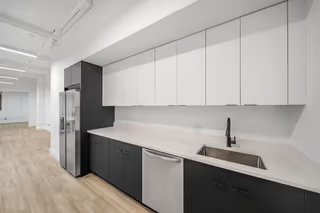 153 W 27th Street [Partial 3rd Floor] 2,978 sq ft $44/sq ft Chelsea
 -
 900 Broadway [Suite 202] 4,000 sq ft $115/sq ft Union Square
 -
 6 Greene Street [Entire 2nd Floor] 4,900 sq ft $78/sq ft SoHo
 -
 30 West 21st Street [Penthouse floor] 5,250 sq ft $115/sq ft Flatiron
 -
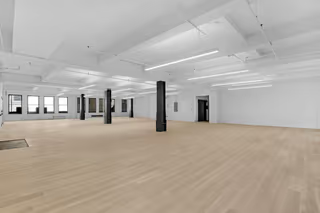 213 West 35th Street [10th Floor] 5,250 sq ft $50/sq ft Penn Plaza
The team
The people you'll actually deal with
Tenant-side brokers, builders and operators, 300+ New York offices delivered between them.
Meet the whole team → Matthew DeRose
 Megan Gallagher
 Nicholas Hein
 Adam Justin
 David Greene
Talk to a broker
Availability moves daily, get today's version
The spaces above are current as of this week. Tell us team size and timing and a broker sends today's live list for this exact search, with all-in monthly costs, and anything new that has not been published yet.
- Same daya broker replies personally, no automated triage
- Tenant-onlyNomad never represents the landlord
- Open pricingrent and size published before you talk to anyone
- 300+ officesdelivered across 2M+ sq ft in New York
Or call 646-688-3158