How Much Office Space Does a 50-Person Company Need?
A 50-person company needs roughly 8,750 square feet, about 175 sq ft per person once meeting rooms, a pantry, phone booths and circulation are included. In New York that costs approximately $54,688 per month at the current median of $75 per square foot per year. Teams planning to grow past 50 within the lease term usually take 15–25% more and sublet or hold the surplus.
Updated 2026-09-30 · 8,750 sq ft · 19 matching · Nomad Group
 William JanetschekCo-Founder, COO · Nomad Group
The size where offices get real
At fifty people an office starts behaving like infrastructure, with all the obligations the word implies. At the standard 175 per person you are looking at about 8,750 square feet, and that plate has to carry five to seven enclosed rooms, a real pantry, server or storage space, and a reception that is actually staffed rather than implied. Landlords also begin treating a tenant of this size as a covenant worth competing for, and that shift in posture improves everything downstream of it, from the pace of responses to the shape of the concession package.
At the $75 median that anchors our book, the arithmetic comes to $656,250 a year, about $54,688 a month, before operating costs. What deserves more attention is how far that number travels on the neighborhood decision alone. The same team pays nearly $30,000 a month more on an $85 SoHo floor than on a $44 Chelsea one, which is why we push clients to settle the location question early and deliberately. At this size the submarket call moves the budget further than any amenity ever will.
Floors that fit, live
- 1235 Broadway, NoMad: 9,500 sq ft at $60 on the penthouse floor, room for about 54 desks
- 127 West 26th Street, Chelsea: 9,500 sq ft at $50, the entire 7th floor
- 1235 Broadway, NoMad: 9,500 sq ft at $62, with a 3D walkthrough online so you can vet it before leaving your desk
- 137 East 25th Street, Flatiron: 8,308 sq ft at $43, the value entry in the set
Every one of those is a current listing from this site's live book, linked below with photography, maps and the real asking rent rather than a range designed to start a phone call. A fifty-person search in this corridor is genuinely spoiled for stock between $43 and $60, which is not something we can say for every size bracket, and it means the shortlist conversation can start from floors you can walk this week instead of comps pulled from last quarter.
Layout arithmetic nobody shows you
Density is a distribution, not a single number. Fifty people at a 175 average means open desking at roughly 60 square feet a seat, six meeting rooms of assorted sizes, two phone booths for every dozen staff, and circulation quietly consuming a third of the plate before anyone has sat down. The averages also hide how much the building itself decides. An 8,500-foot floor with a centered core can seat 50 comfortably or 42 awkwardly depending on where the columns and the pantry land, and that difference is invisible on a brochure plan, which is why we commission a test-fit on any serious contender before our clients sign anything.
The other arithmetic worth internalizing is that enclosed-office counts drive buildout cost far more than desk counts do. Every partition wall is money and every glass front is more of it, so the culture question, open plan or private offices, deserves a settled answer from leadership before the design meeting rather than a debate conducted during it, when each week of indecision is billed at construction rates.
Negotiating at this weight
A fifty-person tenant signing five years at the median is committing about $3.3M, and landlords price the competition for that covenant accordingly. Expect genuine movement on free rent, where one month per lease year is the custom, on tenant improvement allowances that should fund a third to half of a sensible buildout, and on expansion rights wherever the building actually has room to grant them. None of that arrives unprompted. It arrives because the landlord knows there are four other floors on your tour sheet and a broker keeping score.
Ask for the rights that match your actual plan rather than the ones that sound impressive in a board deck. A first offer on the adjacent floor beats an oversized lease in nearly every scenario we model, and sublet flexibility beats both when the forecast is honest about its own error bars. Send the three numbers that define the search and the four floors above come back as a priced comparison by the next business day.
The tour list, ready-made
Four live floors bracket the fifty-person search as it stands. 137 East 25th at $43 is the value play, 151 West 26th at $64 carries a 3D walkthrough, 1235 Broadway's full fourth floor at $62 has a walkthrough of its own, and 1239 Broadway's rebuilt twelfth, also at $62, is sized for 75 to 80 and suits a team buying its growth room up front. For the same company, the monthly swing across those four runs roughly $30,000 to $48,000, a spread wide enough to be worth an afternoon of walking and narrow enough that the decision will turn on the rooms rather than the rent.
They sit within a fifteen-minute radius of one another, so all four fit into a single day of touring, and something useful happens when you see them that way. The abstract neighborhood debate that can occupy a leadership team for a month collapses into four concrete rooms with published prices, walked back to back in the same afternoon light. That compression is what a corridor this tight, with rents this public, makes possible, and it is the fastest route we know from committee opinion to a signed letter of intent.
After the signature
Somewhere around the fiftieth hire, office operations grow past what anyone can run off the side of a desk. Cleaning contracts, HVAC schedules, security fobs, the snack program, the printer that must simply work: each of these needs an owner, a person or a service, assigned before move-in rather than after the first complaint. Our facilities management practice exists for exactly this handoff. The same firm that ran the lease and the buildout stays on to run the floor, so nothing falls into the gap between vendors and the institutional memory of why the lease reads the way it does never walks out the door.
The alternative works too, an office manager hired in month two to untangle month one, and plenty of companies take that route without regret. The only genuine failure mode is leaving the job to nobody, because a floor without an owner announces itself within weeks. A fifty-person office run well disappears into the background of the company it houses, and that disappearance is the entire job description of a good office.
Twelve months after move-in: what fifty-person floors teach
The post-move pattern across our fifty-person placements is remarkably consistent. Meeting rooms fill first, whatever ratio was built, and bookable rooms become the floor's scarce currency almost immediately, so the companies that thrive impose a booking discipline in month one rather than month six. The pantry turns into the culture's living room, and the extra few thousand dollars spent there returns more daily attendance than any amenity floor the landlord advertised. The desks themselves matter less than anyone argued during design. Teams reorganize their pods within weeks regardless of the plan, which is a standing argument for furniture systems over built walls everywhere the fire code allows it.
Operationally, the floor settles into a rhythm you can set a watch by. Tuesdays and Wednesdays peak, Mondays and Fridays breathe, and the after-hours HVAC rider gets exercised far more than anyone projected, so price it into the lease up front instead of discovering the hourly rate on the first late close. The office manager hire, or the facilities contract standing in for one, pays for itself the first week a vendor no-shows.
The strategic lesson lands at month twelve, when the expansion clause earns the negotiation it took. A headcount of fifty rarely holds for long. The ones holding a first-offer right on the adjacent floor expand over a weekend, and the ones without it start a second search from scratch in whatever market happens to exist by then. That single clause, negotiated back when the landlord wanted the deal, is the cheapest growth insurance in commercial real estate, and it is why the right appears in every term sheet we draft at this size.
The fifty-person search, started properly
Begin with the one-day tour this corridor makes possible. The four live floors named above sit within fifteen minutes of one another, and walking all four against the same brief settles more in an afternoon than a month of internal deliberation tends to manage. Bring the eighteen-month headcount, the transfer scoring, and the monthly ceiling, and plan to leave with a two-floor shortlist and the test-fits already commissioned.
The economics at this size justify that discipline. A $40,000-a-month decision deserves term sheets negotiated in parallel on two floors so that neither landlord prices you as captive, an improvement allowance argued from a priced buildout rather than a round number, and the expansion clause that turns desk fifty-one into a weekend of furniture delivery instead of a second search.
Send the three numbers and the tour effectively books itself: four floors, one afternoon, published rents throughout, and a comparison spreadsheet in your inbox before the walking shoes are off.
And if the team is not fifty yet but the trajectory says it will be, run the search on the trajectory rather than the org chart. The floors above hold from about 43 to 107 desks at standard density, the expansion clauses stretch further still, and the best time to secure fifty-person space is the quarter before the fiftieth offer letter goes out, not the quarter after. Growth that is visible in the hiring plan should be visible in the lease.
How many square feet for 50 employees?
About 8,750 sq ft at 175 sq ft per person. Dense open-plan teams can work at 125–150 sq ft each (7,000 sq ft); teams wanting private offices and generous meeting space run 200–250 (11,250 sq ft).
What does that cost in New York?
At the $75 median, 8,750 sq ft is about $54,688 per month, or $656,250 a year, before electricity, which typically adds $2–4 per square foot.
How many meeting rooms does a 50-person team need?
A working rule is one enclosed room per 8–10 people, so five or six: typically one boardroom, two mid-size rooms, and three or four phone booths. Under-providing booths is the single most common regret in a first buildout.
Should you size for today or for growth?
Size for 12–18 months out. Moving is expensive and disruptive; carrying 20% surplus is usually cheaper than an early move. Where growth is uncertain, expansion rights on an adjacent floor are worth negotiating.
Matching space available now
-
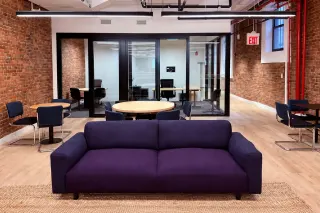 540 Broadway [Entire 2nd Floor] 6,350 sq ft $85/sq ft SoHo
 -
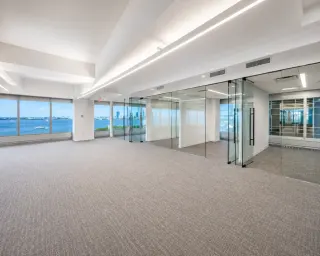 17 State Street [Partial 26th Floor] 6,606 sq ft $79/sq ft FiDi
 -
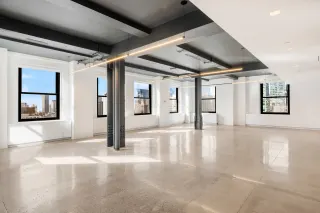 500 Fifth Avenue [Entire 55th Floor] 6,928 sq ft $125/sq ft Bryant Park
 -
 32 Old Slip [Partial 32nd Floor] 6,997 sq ft $64/sq ft FiDi
 -
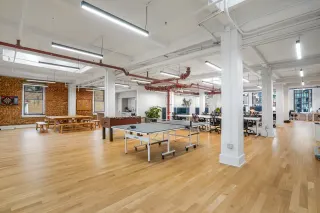 104 West 27th Street [Entire 9th Floor] 7,047 sq ft $59/sq ft Chelsea
 -
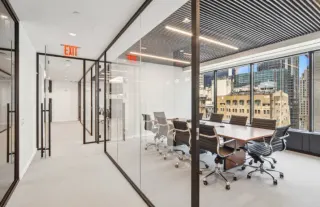 520 Madison Avenue [Partial 21st Floor] 7,092 sq ft $125/sq ft Midtown
The team
The people you'll actually deal with
Tenant-side brokers, builders and operators, 300+ New York offices delivered between them.
Meet the whole team → Matthew DeRose
 Megan Gallagher
 Nicholas Hein
 Adam Justin
 David Greene
Talk to a broker
Availability moves daily, get today's version
The spaces above are current as of this week. Tell us team size and timing and a broker sends today's live list for this exact search, with all-in monthly costs, and anything new that has not been published yet.
- Same daya broker replies personally, no automated triage
- Tenant-onlyNomad never represents the landlord
- Open pricingrent and size published before you talk to anyone
- 300+ officesdelivered across 2M+ sq ft in New York
Or call 646-688-3158