FiDi, NYC: The Neighborhood, From an Office Tenant's Side
FiDi is the value trade every cost-conscious New York tenant should price before signing anywhere else. The Financial District holds the city’s densest transit knot, a dozen lines plus PATH converge at Fulton Street and the Oculus, and twenty years of residential conversion have turned the old 9-to-5 canyon into a real neighborhood with restaurants, hotels and 60,000 residents. The office stock splits between rebuilt prewar bank towers and post-2001 glass, much of it delivered as modern prebuilt floors, and it prices well below Midtown South: comparable space that asks $85 to $100 per square foot in Flatiron regularly trades in the $60s here. For a team that cares about commute coverage and cost per desk more than a fashionable zip code, downtown is the sharpest arithmetic in Manhattan.
Updated 2026-09-30 · Manhattan’s original downtown, modern prebuilt floors and harbor views at rents Midtown South cannot touch · Nomad Group

The oldest streets, the newest floors
FiDi is the one Manhattan submarket where the street grid predates the idea of a grid. Stone Street, Pearl, Beaver and Old Slip follow Dutch cow paths from the 1600s, and the towers stand on them the way a forest stands on a hillside: irregular, dense, occasionally magnificent. That collision is the district's character. You step out of a 44th-floor prebuilt with harbor views and you are on a cobbled lane that has been serving lunch since before the republic.
The office stock splits cleanly in two. The prewar bank towers, 20 Exchange, 70 Pine, One Wall Street's neighbors, carry the marble lobbies and the setback crowns, and their floors have spent two decades being rebuilt to modern spec as the banks consolidated elsewhere. The post-2001 generation around the World Trade Center brought column-free plates, floor-to-ceiling glass and building systems no prewar loft can match. Both generations deliver something Midtown South almost never does: brand-new prebuilt floors, finished, furnished or close to it, ready in weeks.
What changed the district permanently is residential conversion. Some 60,000 people now live below Chambers Street, and the businesses that serve residents, grocers, gyms, schools, actual restaurants that open on weekends, have rebuilt the street level around them. The 9-to-5 ghost town of the 1990s is a memory; the evening now belongs to strollers and running clubs along the East River esplanade.
What it costs against the rest of the book
Our current FiDi floors ask $60 to $115 per square foot around a $72 median, three dollars under the $75 across the whole book, against $85 in SoHo and over $100 on the Union Square premium product. Read carefully: the median climbs that close to the citywide number only because the set includes 4 World Trade Center at $115, trophy product by any measure. The district's value story lives in the other three floors, $60 to $79 for space that would ask $85 to $100 with a Flatiron address.
- 45 Broadway, partial 12th: 2,624 sq ft at $60, the entry point
- 32 Old Slip, partial 32nd: 6,997 sq ft at $64, furnished and wired
- 17 State Street, partial 26th: 6,606 sq ft at $79, harbor panorama
- 4 World Trade Center, partial 44th: 5,023 sq ft at $115, the trophy
For a team of thirty at standard density, the gap between a $64 FiDi floor and an $85 SoHo one is about $110,000 a year. That is the arithmetic that has been quietly pulling priced-out Midtown South tenants over the Brooklyn Bridge's Manhattan landing for a decade.
The transit knot nothing else matches
Fulton Center and the Oculus between them collect the 4/5, 2/3, A/C, J/Z, R/W, 1 and PATH within a ten-minute walk of every floor we list, and the E terminates at the World Trade Center. Whitehall brings the Staten Island Ferry, Pier 11 lands commuter boats from Brooklyn and New Jersey, and the R at Rector fills the local gaps. No other submarket on our book puts this many distinct lines this close together.
The commute pattern it produces is specific: Brooklyn is one or two stops, which is why teams weighted toward brownstone Brooklyn treat FiDi as their nearest Manhattan address. New Jersey rides PATH directly in. The one soft spot is the Metro-North crowd, Grand Central is a 4/5 express ride away, quick, but a ride, and teams with heavy Westchester and Connecticut rosters usually stay near the terminal instead.
Who offices downtown now
Finance never left, but it changed shape: the bulge brackets moved to Midtown and Hudson Yards, and what remains is leaner, funds, fintech, insurance, advisory shops that like the address without needing a trading floor. Around them, the discount has assembled a second economy. Condé Nast anchored One World Trade a decade ago; media, government-adjacent firms and a steady stream of startups priced out of Flatiron have followed.
The newer arrivals share a profile: companies that ran the numbers. They toured Midtown South, priced the difference at their headcount, and bought the extra space or the extra runway instead of the fashionable zip code. In a downturn that trade reads as prudence; in a growth market it reads as an extra engineer per every four or five desks of savings.
Running a FiDi search well
Decide the view question first. Water and harbor views are the district's unfair advantage, 17 State's Statue of Liberty panorama and 32 Old Slip's East River light cost a fraction of what equivalent outlooks command in Midtown, but interior low floors in the same buildings can feel like anywhere. The delta between the two is often only a few dollars; take the view.
Second, use the prebuilt supply honestly. Most of our downtown floors come finished, glass-fronted rooms, pantries plumbed, sometimes furniture in place, which collapses the move-in timeline from months to weeks and the buildout budget toward zero. If your plan needs custom construction, the same landlords will deal, but the district's real gift is speed.
Third, check the amenity package, because downtown towers compete on it: 17 State's tenant amenity center and 25,000 square feet of renovated outdoor plaza, Old Slip's waterfront esplanade a door away, the Oculus mall under 4 WTC for the errand economy. These are the things coworking refugees miss, and here the building supplies them.
The floors on the book right now
Four floors, four different arguments. 45 Broadway's partial 12th is the entry: 2,624 square feet at $60, a modern prebuilt with three glass-fronted offices, a conference room, pantry and open area for a first real office, about 15 desks. 32 Old Slip's partial 32nd brings 6,997 feet at $64, furnished, wired and bright, with Downtown and waterfront views, the immediate-move-in play for a 40-person team.
17 State Street's partial 26th is the view floor: 6,606 feet at $79 with direct elevator exposure and a panoramic sweep of the harbor and the Statue of Liberty, plus the amenity center and plaza below. And 4 World Trade Center's partial 44th is the statement: 5,023 column-free feet at $115, five offices, two conference rooms, reception and open seating, floor-to-ceiling glass, the Oculus and every train in the borough underneath.
Every rent is printed on its page, and all four fit the 15-to-40-desk band where most growing teams actually land.
How deals here tend to trade
Downtown landlords are volume operators with real vacancy to move, which shapes the negotiation in the tenant's favor. Concession packages run richer than Midtown South: more free rent on equivalent terms, and buildout contributions that matter less than usual because the floors come prebuilt. Asking rents hold steadier, the flexibility lives in the package, not the headline.
Terms skew practical. Five-to-seven-year deals on prebuilt floors sign quickly because there is nothing to construct; shorter runs are negotiable in a way Flatiron rarely allows, and the district's supply depth means an expiring tenant can usually trade up inside the same zip code. The tenant's discipline is the usual one: keep two floors live until term sheet, and let the published numbers open the conversation.
A day in the life, downtown edition
The 8:50 arrivals surface from Fulton Center and the Oculus and walk canyon streets that are half finance, half film set. Coffee happens on Stone Street or in the Oculus concourse; the 10 a.m. all-hands happens against a window full of harbor. Lunch is the district's quiet upgrade, the Seaport's restaurant row, Stone Street's tables, the Battery's lawns, all inside ten minutes on foot.
Afternoons run long because leaving is easy: every borough's trains are downstairs. The 6:30 crowd splits between the esplanade runners, the ferry commuters reading on deck, and the residents, because a growing share of every downtown team now lives inside the district it works in, which is the conversion story landing exactly as intended.
Is FiDi your answer? The arithmetic test
Run three numbers. First, your roster's commute map: if Brooklyn, New Jersey and downtown Manhattan dominate, FiDi is likely the shortest average ride your team can be offered; if Metro-North dominates, stay near Grand Central. Second, the rent delta at your headcount: price a $64 downtown floor against the $85 SoHo or $100-plus Union Square equivalent and name what the difference funds. Third, the timeline: if you need to be in by next quarter, the prebuilt depth here is the strongest in Manhattan.
When two of the three land downtown, the tour books in one email. All four floors publish their rents, sizes and photo sets on this site, and a walkthrough of the shortlist takes an afternoon, ferries optional.
What is FiDi known for?
Wall Street and the New York Stock Exchange most famously, plus the World Trade Center campus, the Oculus transit hub, Battery Park and the harbor ferries. It is the oldest part of the city, Dutch-era streets under 20th-century towers, and since the 2000s one of its fastest-growing residential neighborhoods.
Is FiDi a good place for an office?
For value and commute coverage, it is the strongest case in Manhattan. Nearly every subway line, PATH and the ferries land within a ten-minute walk, the towers deliver modern prebuilt floors with light and views, and asking rents run 20 to 40 percent below equivalent Midtown South space. The trade is atmosphere: the streets skew corporate by day and quiet late, though the residential conversion narrows that gap every year.
How do people get to FiDi?
From almost anywhere. The 4/5 and 2/3 express trunks stop at Wall and Fulton, the R/W, 1 and J/Z fill the local grid, PATH brings New Jersey into the Oculus, and Staten Island arrives by ferry at Whitehall. Brooklyn commutes are the quiet advantage: one or two stops over the bridge tunnels beats any Midtown ride.
Who offices in FiDi?
Finance still anchors it, but the discount has pulled in media, insurance, government-adjacent firms and a growing band of startups priced out of Midtown South. Condé Nast moved to One World Trade a decade ago and the mix has broadened since: the typical newer tenant is a company that ran the numbers on a Flatiron floor and bought twice the space downtown instead.
What does office space cost in FiDi?
Across Nomad's current FiDi availability, asking rents run $60–$115 per square foot per year, median $72, every listing publishes its rent, size and address. The live availability sits on the FiDi submarket page.
Matching space available now
-
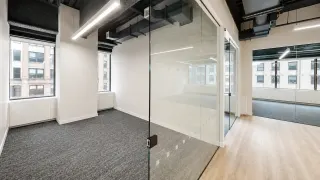 45 Broadway [Partial 12th Floor] 2,624 sq ft $60/sq ft FiDi
 -
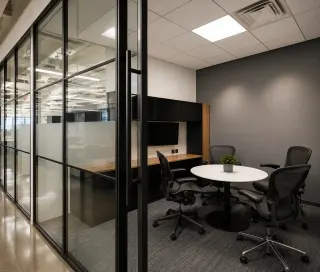 4 World Trade Center [Partial 44th Floor] 5,023 sq ft $115/sq ft FiDi
 -
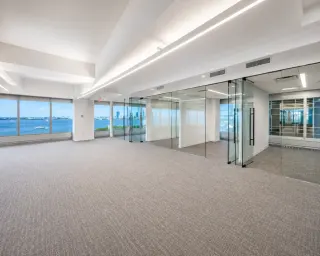 17 State Street [Partial 26th Floor] 6,606 sq ft $79/sq ft FiDi
 -
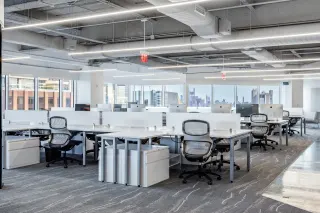 32 Old Slip [Partial 32nd Floor] 6,997 sq ft $64/sq ft FiDi
The team
The people you'll actually deal with
Tenant-side brokers, builders and operators, 300+ New York offices delivered between them.
Meet the whole team → William Janetschek
 Matthew DeRose
 Megan Gallagher
 Nicholas Hein
 Adam Justin
 David Greene
Talk to a broker
Availability moves daily, get today's version
The spaces above are current as of this week. Tell us team size and timing and a broker sends today's live list for this exact search, with all-in monthly costs, and anything new that has not been published yet.
- Same daya broker replies personally, no automated triage
- Tenant-onlyNomad never represents the landlord
- Open pricingrent and size published before you talk to anyone
- 300+ officesdelivered across 2M+ sq ft in New York
Or call 646-688-3158