Grand Central vs Hudson Yards: Office Space Compared
Grand Central office space runs a median of $81 per square foot per year against $200 in Hudson Yards, Grand Central is about 60% cheaper. Nomad currently has 2 spaces in Grand Central and 1 in Hudson Yards.
Updated 2026-09-30 · $81 vs $200 per sq ft · Nomad Group
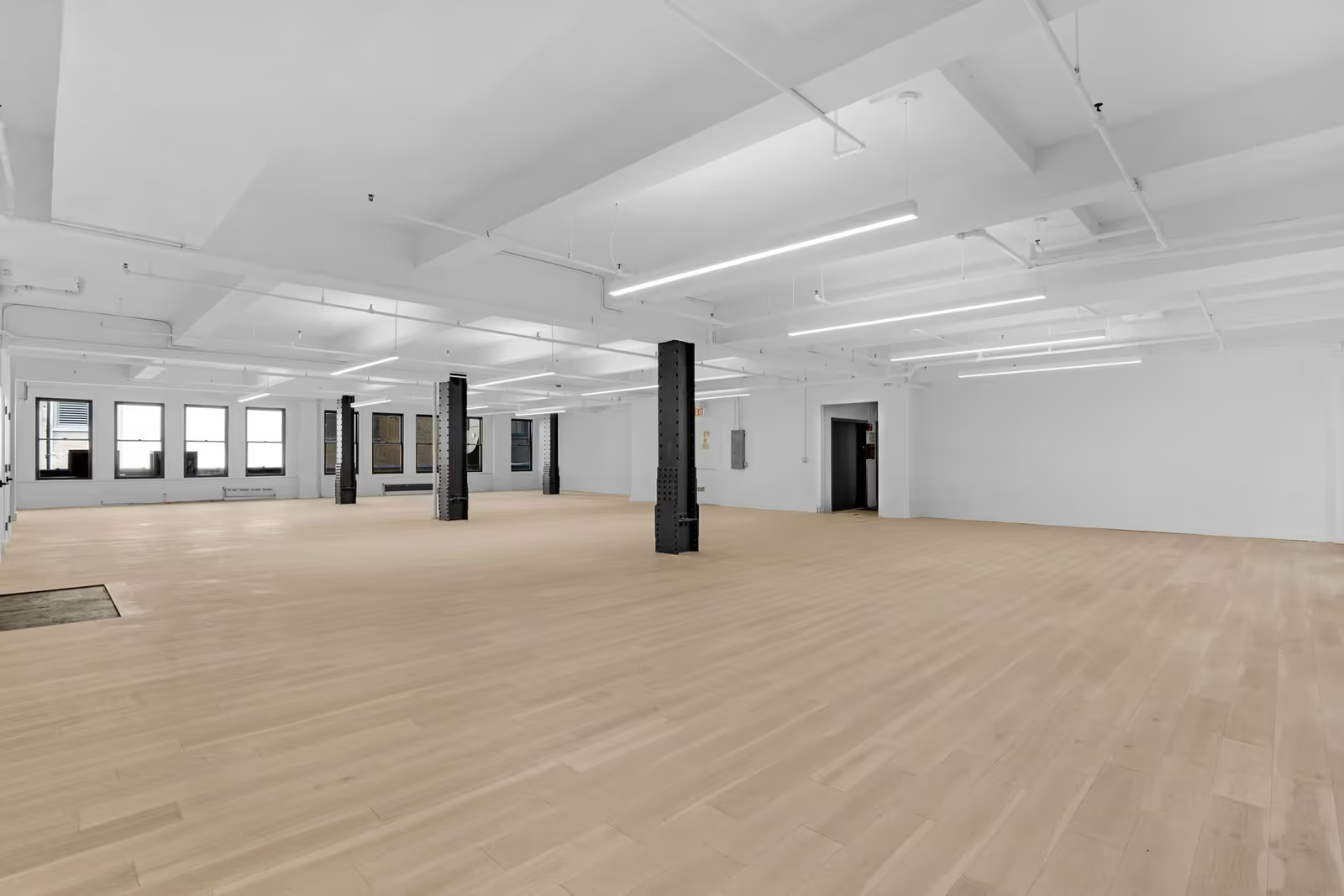
Rents, sizes and monthly figures come from our current availability in both submarkets, the 175 square feet per person from the standard we plan every floor against, and the citywide comparison from the $75 median across the 49 floors on our book. Two floors against one is a thin comparison and it changes the day either book moves. We hold no description of the Hudson Yards floor or of 60 East 42nd Street, so nothing here describes their condition.
The gap is $119 a foot, and what sits behind it
Median asking rent in Grand Central is $81 per square foot per year against $200 in Hudson Yards. That is a difference of $119 a foot, about 60 percent off the Hudson Yards number, and one of the widest gaps between any two submarkets on our book. Run it on the only Hudson Yards floor we hold: 10,517 square feet at $200 is $2,103,400 a year and about $175,283 a month, while the same footprint at the Grand Central median would be $851,877 and about $70,990. The difference is $104,293 every month and $1,251,523 a year, better than $6 million across a five-year term.
Read both medians as small samples rather than market indices. Grand Central's $81 is the midpoint of exactly two rents, $72 and $89, with nothing between them to test it. Hudson Yards' $200 is one asking price on one floor, which makes it a quote rather than a median. Against the $75 that sits in the middle of the 49 floors we represent citywide, Grand Central runs about 8 percent high and Hudson Yards about 167 percent high, and 60 East 42nd Street asks $72, three dollars under the citywide median.
What each submarket is selling explains the rest. Hudson Yards is the newest office district in Manhattan, purpose-built towers raised over the West Side rail yards in the last decade, and the floor in question sits high in 66 Hudson Boulevard, The Spiral. Grand Central is East Midtown around the terminal, unmatched for commuters from Westchester and Connecticut, where the premium over the citywide median buys the railroad rather than the building's age. One sells a decade. The other sells a train.
Two floors against one, and what each can house
Grand Central is two floors, 5,230 and 5,772 square feet, about 30 and 33 desks at the 175 square feet per person we plan against. Hudson Yards is one floor, 10,517 square feet, about 60 desks. Three floors total, and they cover two headcounts.
- Grand Central: 60 East 42nd Street, Partial 13th Floor, 5,772 sq ft at $72, about $34,632 a month, and our record carries nothing about its condition, so that is a tour question; 825 Third Avenue, Partial 29th Floor, 5,230 sq ft at $89, about $38,789 a month, boutique floorplates with floor-through sightlines and long-range views, with dynamic glass in every window that tints to cut glare.
- Hudson Yards: 66 Hudson Boulevard, Partial 53rd Floor, 10,517 sq ft at $200, about $175,283 a month. We hold no description of its condition or layout either, so whether it arrives raw, pre-built or furnished is the first thing to establish on a tour.
The cleanest way to see the gap is to buy the same amount of space in each. Both Grand Central floors together are 11,002 square feet and about 63 desks for roughly $73,421 a month. The one Hudson Yards floor is 10,517 square feet and 60 desks for $175,283. So 485 more square feet and three more desks, in Grand Central, cost $101,862 a month less. Per desk per year that is about $13,985 against $35,057.
There is a catch, and it cuts the other way. Neither Grand Central floor houses 60 people alone, and the two sit in different buildings, so a team of that size would be splitting itself across two addresses or looking outside this submarket. If you need one floor for 60, Hudson Yards is currently the only one of the two that has it.
Two railroads and one shared subway line
Grand Central runs 4/5/6, 7, S, Metro-North. Hudson Yards runs the 7 at 34th Street Hudson Yards, with the A/C/E and the LIRR at Penn a few blocks east. The 7 is the only service both strings carry, and it happens to run between the two addresses, which makes this the rare Manhattan comparison where one line serves both ends.
Everything else about the commute diverges. Grand Central is the Metro-North submarket, and for a company with real volume from Westchester or Connecticut that is close to decisive: people step off the train and are already at work, at both ends of the day, for the whole term. Hudson Yards answers to Penn instead, where the LIRR, NJ Transit and Amtrak land, so a team drawing from Long Island or New Jersey is better served there, with a walk west attached.
It also matters where the rest of your staff lives. Grand Central sits on the east-side subway trunk with the 4/5/6, the 7 and the S; Hudson Yards has the 7 and whatever your staff will walk from Penn. Collect the home stations of the people you already employ, count transfers rather than minutes, and do it before the tour rather than after the letter of intent.
The recommendation, without the hedging
For a team of about 30, Grand Central, and start with 60 East 42nd Street. It is the larger of the two floors, it asks $72 against a citywide median of $75, and at about $34,632 a month it costs less than a fifth of the Hudson Yards floor. If the money is available and the brief is client-facing, 825 Third Avenue is worth the extra $4,157 a month for floor-through sightlines and glass that manages its own glare.
For a team of about 60 that wants one floor, Hudson Yards is the only answer between these two, and it is an expensive one. Before signing, price the alternative honestly: 60 desks elsewhere on our book, in Bryant Park or Midtown, runs a fraction of $175,283 a month. Pay the Hudson Yards premium when the building itself is part of what you sell to clients and candidates, and when the newest construction in New York is a genuine requirement rather than a preference. There is no substitute for it, which is exactly why it prices the way it does.
And be honest about the shape of this comparison. One floor against two is thin on both sides. What would make it real is depth in Hudson Yards, a second and third floor at different sizes and price points, which would tell us whether $200 is the district or just this plate. Until then the Hudson Yards column is a single quote.
The practical next step
Three floors across two submarkets is a half-day, not a campaign, and the 7 connects them. Walk Hudson Yards first while the number is still abstract, then the two Grand Central floors, and the comparison will make itself in the rooms rather than on the page.
On every one of the three, establish what our record does not carry: condition as delivered, the existing layout and whether it survives, the loss factor in writing with a measured plan, and what ownership will contribute to a buildout. At the top of the market the headline rent moves least, so the money is in term, free rent, allowance and a capped escalation.
We represent tenants only and publish every rent we hold. Send the headcount you carry today, the one you expect in three years and the monthly number you will not cross, and we will model both submarkets across the full term rather than per foot.
Is Grand Central more expensive than Hudson Yards?
No, Grand Central is about 60% cheaper, $81 against $200 per square foot per year. Both figures are medians of Nomad's current availability.
Which suits a growing team better?
Grand Central: East Midtown around the terminal, unmatched for Westchester and Connecticut commuters. Hudson Yards: The newest office district in Manhattan, purpose-built towers over the rail yards on the far West Side. The deciding factor is usually commute and the rent difference on the floor size you actually need.
How do they compare on transit?
Grand Central, 4/5/6, 7, S, Metro-North. Hudson Yards, 7 at 34th Street Hudson Yards, A/C/E and LIRR at Penn.
Can we tour both submarkets in one day?
Yes. These submarkets sit minutes apart; a well-planned tour covers four to six floors across both in an afternoon, which is the fastest way to make this comparison real.
How firm are the boundaries between these neighborhoods?
Soft. Brokers and landlords shade labels a block or two in whichever direction sounds better. Judge the block and the building, not the name on the map.
The team
The people you'll actually deal with
Tenant-side brokers, builders and operators, 300+ New York offices delivered between them.
Meet the whole team → William Janetschek
 Matthew DeRose
 Megan Gallagher
 Nicholas Hein
 Adam Justin
 David Greene
Talk to a broker
Availability moves daily, get today's version
The spaces above are current as of this week. Tell us team size and timing and a broker sends today's live list for this exact search, with all-in monthly costs, and anything new that has not been published yet.
- Same daya broker replies personally, no automated triage
- Tenant-onlyNomad never represents the landlord
- Open pricingrent and size published before you talk to anyone
- 300+ officesdelivered across 2M+ sq ft in New York
Or call 646-688-3158