Grand Central, NYC: The Neighborhood, From an Office Tenant's Side
Grand Central is the office market the terminal built. Every morning Metro-North empties Westchester and Connecticut into it, and since Grand Central Madison, Long Island too, which is why the surrounding blocks read institutional: professional-services firms, funds and client-heavy businesses whose partners and visitors arrive by rail. The stock splits cleanly between prewar boutique buildings on the side streets, where full floors run small and dignified, and the new trophy towers rising on the avenues around One Vanderbilt.
Updated 2026-09-30 · The institutional address for firms that live on Metro-North · Nomad Group
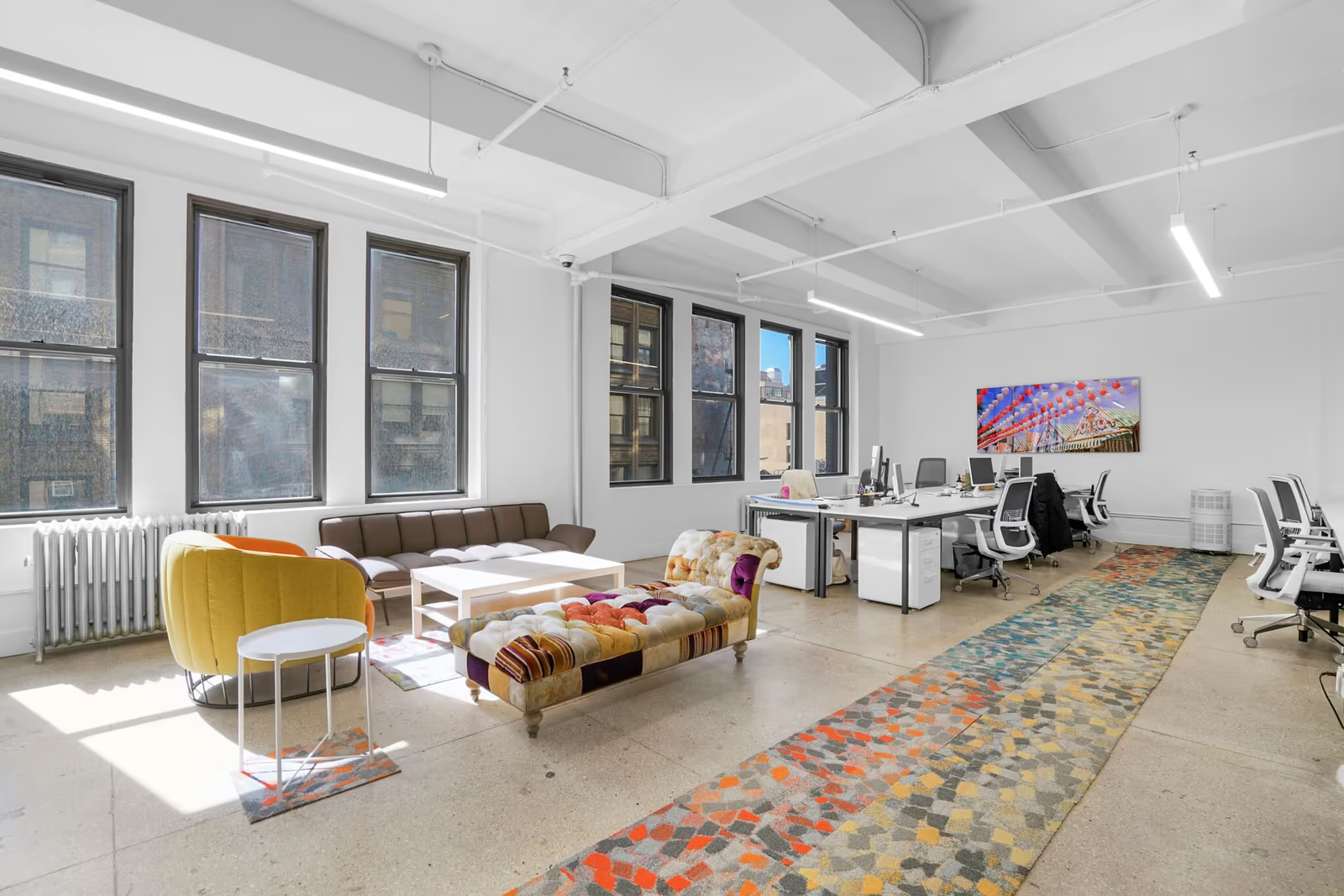
The commuter capital
Grand Central is where the metro area's suburban talent enters Manhattan: Metro-North from Westchester and Connecticut, the Long Island Rail Road's newer East Side Access platforms underneath, and the 4/5/6, 7 and S inside the terminal. An office within three blocks means a senior hire in Greenwich or Garden City steps off one train and walks to a desk.
That is the neighborhood's entire case, and for the right team it is decisive. Companies whose partners and rainmakers live north and east of the city have clustered here for a century for exactly this reason, and the pattern has outlived every cycle of downtown fashion.
The stock, from terminal towers to side-street value
Park and Madison in the 40s carry the marquee towers, One Vanderbilt at the top of the market. But the side streets, 44th through 48th between Madison and Third, hold older mid-rise stock where sensible money offices: prewar and postwar buildings with floors of 3,000 to 10,000 square feet at rents far below the avenue addresses.
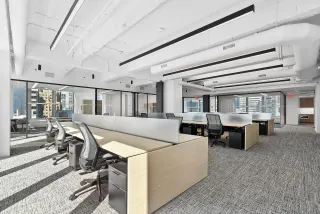
- Our current floors: 60 East 42nd Street, partial 13th, 5,772 square feet at $72; and 825 Third Avenue, partial 29th, 5,230 square feet at $89, its windows glazed in auto-tinting View Glass
- Together they seat about 63 people at standard density, 33 and 30 a floor
- Both publish full photo sets, floor plans and true numbers on this site
At $72 and $89 against One Vanderbilt-tier avenue pricing, the two floors are the neighborhood's argument in one line: terminal adjacency without trophy-tower pricing.
What the neighborhood is like to work in
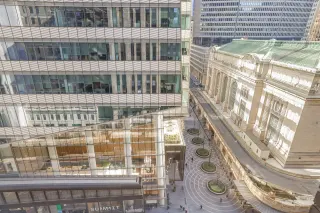
More polished than the loft districts, less corporate than Sixth Avenue. The terminal itself is the amenity, its food hall and market beat most office cafeterias, and the blocks around it have quietly gained the restaurant depth that used to require a trip downtown. Summer streets around Pershing Square put tables under the viaduct.
The trade-off against Midtown South is texture: fewer galleries and boutiques, more banks and barbers. Staff who wanted a SoHo address will notice; staff who commute from Larchmont will not care even slightly.
Who it suits
Professional firms, finance-adjacent companies, and any business whose org chart leans suburban. It also suits satellite offices of out-of-town companies, when the New York office exists partly to meet clients, being one walk from their train beats being one subway ride.
Running a Grand Central search well
Decide avenue or side street first; they are different markets sharing a name, and the delta is routinely $40 a foot. Check floor plates against your meeting load, this stock skews to enclosed offices and can under-supply open desks without a reconfiguration, and confirm after-hours HVAC terms, the older side-street buildings vary widely.
Then use the imagery. Both current floors publish complete photo sets and floor plans, and twenty minutes with them answers most of what a first visit would, which matters when your decision-makers are in three suburbs.
Walk the floor before you visit
Both Grand Central floors publish complete photo sets, floor plans and true numbers, which changes how a suburban-decision-maker search runs: the Westchester partner reviews the floor from a desk in Rye, the Connecticut partner from Greenwich, and the one physical tour happens with the shortlist already agreed. Several floors on the wider book carry full Matterport scans as well, so where the search widens beyond the terminal, the walkthrough itself happens from a laptop.
At 5,772 and 5,230 square feet, the two floors seat about 33 and 30 at standard density, with the enclosed-office-friendly layouts this stock favors, which suits professional firms exactly as found.
How deals here tend to trade
The avenue towers negotiate institutionally, slow, documented, covenant-obsessed, while the side-street holdings behave like the lofts downtown: reachable owners, faster yeses, flexibility on term. Knowing which kind of building you are in decides the playbook before the first call.
The commuter-rail premium is priced into the avenues but only loosely into the side streets, which is the arbitrage this guide keeps pointing at: terminal adjacency at a mid-corridor rent exists here, our current floor is the proof, and it trades quickly when companies notice. Concession norms match the corridor, a month of free rent per lease-year, allowances tracking term.
A day in the life, Grand Central tenant edition
The rhythm of an office here follows the rails. Mornings compress: the 8:02 from Rye and the 8:11 from Greenwich land within minutes of each other, and the office fills in a wave rather than a trickle, which teams learn to schedule around, standups at 9:15 land better than 9:00 sharp. Client days run frictionless, visitors step off Metro-North or the 4/5/6 and arrive without weather touching them, and the terminal's food hall covers the working lunch at every price point.
Evenings give the neighborhood back its commuter logic: the office empties toward trains rather than bars, which suits firms whose culture runs suburban and family-shaped, and mildly frustrates teams wanting Thursday drinks energy, Flatiron is two stops away when needed. The trade is explicit, and for partner-heavy firms it is the right one: presence beats nightlife when the roster lives in Westchester.
Twelve months in, tenants here report the thing the guide promised: the commute complaint disappeared from reviews and negotiations. For firms hiring senior talent out of the suburbs, that silence is worth exactly what the neighborhood asks, which, on our current side-street floor, is $72, three dollars under the citywide median.
Is Grand Central your answer? The roster test
Pull up the leadership roster and count the Metro-North and LIRR addresses; that number is the neighborhood's entire case, made or unmade. Three or more and the terminal district belongs on the shortlist, the daily hour it returns to each of those commutes compounds into retention that no amenity buys. Zero, and the corridor's loft districts probably fit the company's centre of gravity better.
The middle cases weigh the client geometry too: companies whose visitors arrive by train or plane find the terminal's convenience shows up in meeting acceptance rates, a soft metric that sales leadership will confirm enthusiastically.
The current 825 Third Avenue floor makes the test concrete: review its photo set tonight, price its $89 against the citywide $75 median, and if the roster test says yes, the tour books in one email with the three numbers attached.
What is Grand Central known for?
The 1913 terminal, the constellation ceiling, the clock, and its role as the suburban gateway: Metro-North from the north, LIRR beneath via Grand Central Madison, and the 4/5/6 and 7 below that.
Is Grand Central a good place for an office?
If the team or the clients ride commuter rail, nothing else competes, the walk from track to desk can be four minutes. Teams hiring young engineers who live in Brooklyn usually look south instead; this is the suburb-facing submarket.
What kind of buildings are available?
Two products: side-street prewar boutiques with small full floors that suit funds and firms, and avenue trophy towers for scale. The boutique stock is the quiet value, dignified buildings a block from the terminal.
Who offices near Grand Central?
Law, finance, consulting and the businesses that serve them; increasingly, companies chasing Long Island talent since the LIRR arrived under the terminal.
What does office space cost in Grand Central?
Across Nomad's current Grand Central availability, asking rents run $72–$89 per square foot per year, every listing publishes its rent, size and address. The live availability sits on the Grand Central submarket page.
The team
The people you'll actually deal with
Tenant-side brokers, builders and operators, 300+ New York offices delivered between them.
Meet the whole team → William Janetschek
 Matthew DeRose
 Megan Gallagher
 Nicholas Hein
 Adam Justin
 David Greene
Talk to a broker
Availability moves daily, get today's version
The spaces above are current as of this week. Tell us team size and timing and a broker sends today's live list for this exact search, with all-in monthly costs, and anything new that has not been published yet.
- Same daya broker replies personally, no automated triage
- Tenant-onlyNomad never represents the landlord
- Open pricingrent and size published before you talk to anyone
- 300+ officesdelivered across 2M+ sq ft in New York
Or call 646-688-3158