Hudson Yards, NYC: The Neighborhood, From an Office Tenant's Side
Hudson Yards is the newest purpose-built office district in Manhattan, and the newness is the whole argument. The neighborhood was built over the West Side rail yards inside the last decade, so every floor in it is new construction on current systems, without the compromises a prewar conversion carries, and the city extended the 7 train west to serve it. The High Line ends at its southern edge and Penn Station is a walk east. The pricing follows, at the top of the city. A company that wants the newest building in New York and has budgeted for it should be here, and a company looking for value should be a few blocks east in Penn Plaza instead.
Updated 2026-09-30 · The trophy submarket: the newest offices in New York, priced at the top of the city · Nomad Group
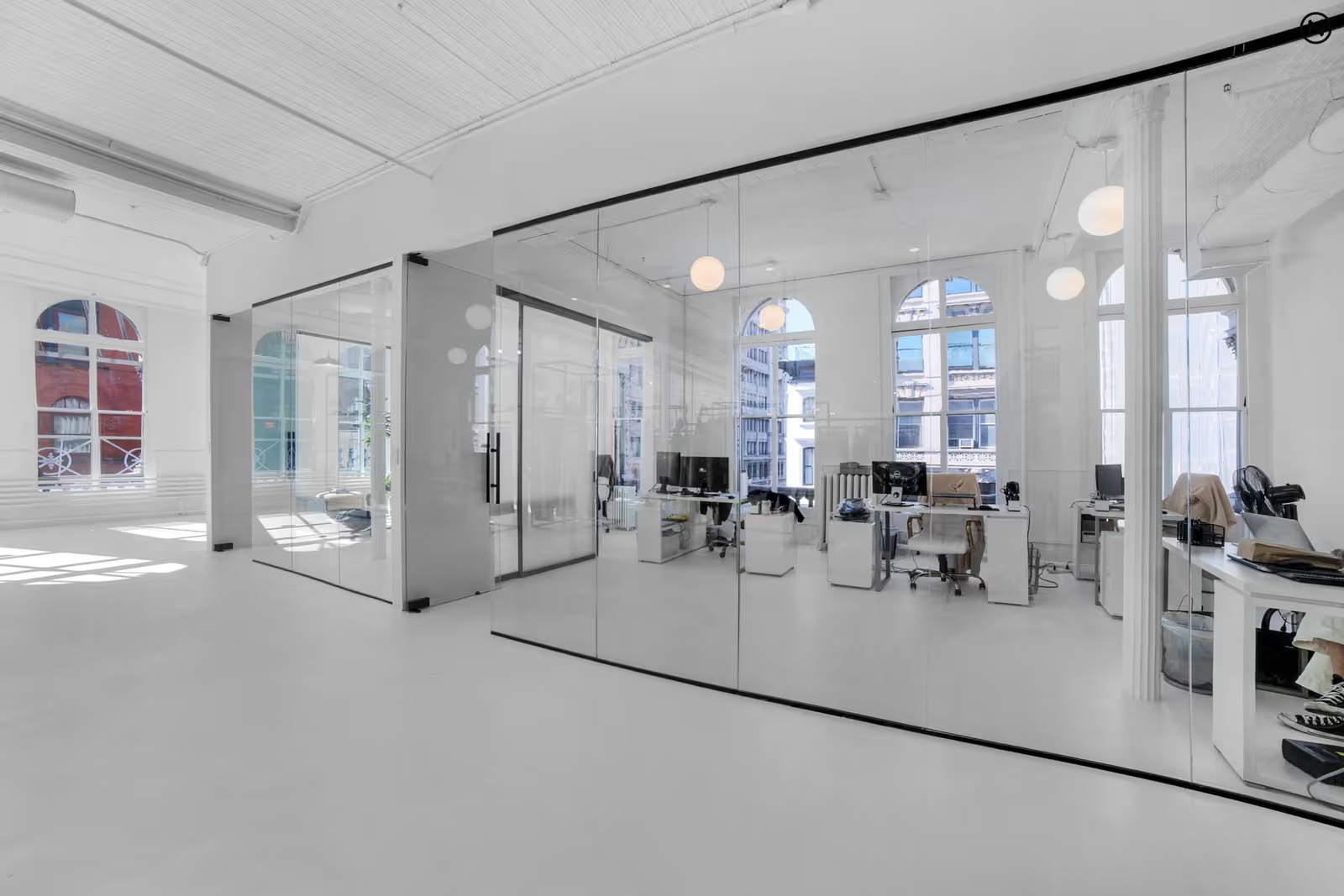
What the district actually is
Hudson Yards is the only office neighborhood in Manhattan that did not exist twenty years ago. It was raised over the West Side rail yards inside the last decade, which means there is no prewar stock in it, no conversion compromise and no inherited building systems anywhere. Every floor is new construction on current systems, the city extended the 7 train west to reach it, and the High Line ends at its southern edge.
That origin explains the neighborhood’s texture as much as its pricing. A district built whole, over a working rail yard, on a schedule, arrives finished rather than accumulated, and tenants tend to react to that within about ten minutes of stepping off the 7. Either the newness reads as the point, or it reads as expensive. We have watched both reactions many times and neither one is wrong.
For an office tenant the practical consequence is narrow and genuinely useful. If what you want is a floor built in the last decade, on the newest systems, in a tower designed as an office tower rather than adapted into one, this is where that exists. Chelsea and NoMad and SoHo cannot offer it at any price, because they are made of other centuries.
The one floor on the book, and what $200 buys
We represent one floor in Hudson Yards: a partial 53rd at 66 Hudson Boulevard, The Spiral, 10,517 square feet asking $200 per square foot per year. That is $2,103,400 a year and about $175,283 a month, and at the 175 square feet per person we plan every floor against it seats roughly 60 people, which works out near $35,057 per desk per year.
Set that against the rest of the book and the number stops being abstract. Across the 49 floors we represent citywide the median asking rent is $75, so this floor sits about 167% above it, and the next most expensive thing we hold anywhere is 2 Penn Plaza at $135. Bryant Park’s trophy floors run $65 to $125 with a median of $96. SoHo’s median is $98, Midtown’s is $125, Chelsea’s is $56. Hudson Yards does not lead that list by a nose. It is $65 a foot clear of second place.
What we cannot tell you is what the floor itself looks like. Our record carries no description of its condition, layout, exposures or what comes with it, and we would rather say that than fill the gap with adjectives. Those are the first questions to put to ownership on a tour, and the answers move the value of $200 considerably in either direction.
Who belongs here, and who should walk east
The tenant this submarket genuinely suits is specific. The building is part of what the company sells, to clients who fly in, to candidates it is competing hard for, or to a board that reads an address as a signal. The headcount sits near 60, so one floor does the job. And $175,283 a month is a number the business absorbs without arguing about it every quarter. For that tenant there is no substitute anywhere in New York, because nowhere else offers a floor built this recently.
Everybody else should walk east. Penn Plaza sits on the same commuter rail a few blocks away at a median of $52, with floors from $50 to $135, and it is the value answer for a company that wants the Penn Station catchment without the Hudson Yards number. Midtown is the other direction to look: four floors, 7,092 to 19,097 square feet, a median of $125 and a range starting at $79, which buys the corporate core and the deepest supply of full-floor space on our book.
There is a size problem too, and it deserves saying plainly. Hudson Yards on our book is one floor at one size. A team of 25 has nothing here. A team of 100 has nothing here. Penn Plaza’s floors run 5,070 to 6,100 square feet and Midtown’s stretch to 19,097, so the neighbors cover bands this district currently does not.
Getting there, and what the commute means for hiring
The 7 terminates at 34th Street Hudson Yards, which puts Times Square and Grand Central a few stops east. Penn Station is the bigger story for most commuters: the A/C/E, the 1/2/3, the LIRR, NJ Transit and Amtrak all land a few blocks away, and plenty of people walk that rather than transfer.
For hiring, read that as strength on one axis and a real weakness on another. Anyone arriving by commuter rail from New Jersey or Long Island lands close, and for a leadership team that comes in from those directions the case makes itself. Staff travelling from Brooklyn, Queens or the east side of Manhattan are looking at a transfer onto the 7 or a walk west from Penn, and that last leg is what people quote back to you eighteen months into a lease.
The test is the same one we run everywhere and it takes an afternoon. Collect the home stations of the people you already employ, count transfers rather than minutes, and do it before the tour rather than after the letter of intent. A lease runs five to ten years. Twenty minutes added each way is a retention cost that never appears in a rent comparison.
How to approach a trophy floor in a new district
At $200 a foot the headline rent is the least negotiable thing in the deal, and the rest of the package is where the money sits. Push on term, free rent, the improvement allowance and the escalation structure, and ask for the escalation capped as a stated percentage rather than tied to an index. On a floor this size one month of free rent is worth $175,283, so three months across a five-year term takes a real slice off the blended cost without asking the landlord to reprice the building.
A tour of a floor we hold no description for should be run as fact-finding, not viewing. Establish the condition as delivered, whether an existing layout is staying and whether it suits you, the loss factor in writing with a measured plan, what ownership will contribute to a buildout and on what schedule, the electrical capacity if your hardware is heavier than laptops, and what else in the building rolls during your term. Bring an architect to the second visit, not the fifth.
And hold a live alternative the whole way through. In this submarket that usually means a Penn Plaza floor or a Midtown floor you would genuinely sign, priced and ready, because the only leverage a tenant has at the top of the market is a credible willingness to walk. A premium is defensible once you have made it argue for itself against a real number.
What would make this a real cluster
Right now Hudson Yards on our book is a single quote rather than a market. One floor, at one size, at one price, tells you what that floor costs. It cannot tell you whether $200 is the district or just this plate, what a tenant’s alternatives look like at 5,000 or 20,000 square feet, or how hard any of it negotiates.
What would change that is depth: a second and third floor here at different sizes and different price points, ideally in different buildings, enough that a median means something and a shortlist is possible. That is how Chelsea and SoHo became submarkets we can write about with confidence, at nine floors apiece. Until Hudson Yards gets there, read this as a guide to one address in a new district rather than a survey of the district itself.
We will say so on the day it changes. In the meantime, if the newest building in New York is what the business actually needs, we will tour it, price it honestly against Penn Plaza and Midtown, and negotiate it as tenant-only counsel with nobody on the landlord’s side of the table.
What is Hudson Yards known for?
Being new. The district was raised over the West Side rail yards in the last decade, the newest purpose-built office neighborhood in Manhattan, and its towers are the most recent things on the skyline. The 7 train was extended west to serve it, and the High Line, which starts down in the Meatpacking District, ends at its southern edge.
Is Hudson Yards a good place for an office?
For a company that wants the newest space in New York and can pay the top of the market for it, yes, and there is no substitute, because nowhere else on the island offers a floor built this recently. For everyone else the honest answer is no. Hudson Yards asks more than any other submarket in the city, the value submarkets are a walk away, and a team that would feel the rent every month should be touring Penn Plaza or Chelsea instead.
How do people get to Hudson Yards?
The 7 was extended west in 2015 and terminates at 34th Street Hudson Yards, which puts Times Square and Grand Central a few stops away. Penn Station is the bigger story for most commuters: the 1/2/3, A/C/E, LIRR, NJ Transit and Amtrak all land a few blocks east, and plenty of people walk that rather than transfer.
Hudson Yards or Penn Plaza?
Neighbors, and opposites. Hudson Yards is new construction at the top of the city’s pricing; Penn Plaza is garment-district loft being repositioned a few blocks east, sitting on the same commuter rail, at $50 to $135 per square foot per year against $200. Tenants who tour both tend to settle it in the first ten minutes: either the building is the point, or the commute and the number are.
Why does Hudson Yards cost so much more than the rest of Manhattan?
New construction, and very little of it. The one Hudson Yards floor we list, a partial 53rd at 66 Hudson Boulevard, The Spiral, asks $200 per square foot per year, the most expensive space on our whole book by a wide margin. The next dearest floor we hold is 2 Penn Plaza at $135, and the median across the floors we price is $75. At 10,517 square feet, that Hudson Yards floor runs $175,283 a month. It is a real number and a tenant should look at it as one before falling for the address.
What does office space cost in Hudson Yards?
Across Nomad's current Hudson Yards availability, asking rents run $200 per square foot per year, every listing publishes its rent, size and address. The live availability sits on the Hudson Yards submarket page.
Matching space available now
See all 49 available floors, with rents →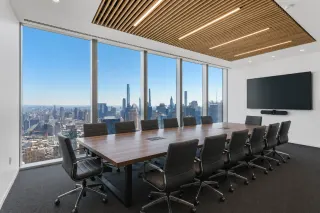
The team
The people you'll actually deal with
Tenant-side brokers, builders and operators, 300+ New York offices delivered between them.
Meet the whole team → William Janetschek
 Matthew DeRose
 Megan Gallagher
 Nicholas Hein
 Adam Justin
 David Greene
Talk to a broker
Availability moves daily, get today's version
The spaces above are current as of this week. Tell us team size and timing and a broker sends today's live list for this exact search, with all-in monthly costs, and anything new that has not been published yet.
- Same daya broker replies personally, no automated triage
- Tenant-onlyNomad never represents the landlord
- Open pricingrent and size published before you talk to anyone
- 300+ officesdelivered across 2M+ sq ft in New York
Or call 646-688-3158