Flatiron vs Hudson Yards: Office Space Compared
Flatiron office space runs a median of $72 per square foot per year against $200 in Hudson Yards, Flatiron is about 64% cheaper. Nomad currently has 6 spaces in Flatiron and 1 in Hudson Yards.
Updated 2026-10-01 · $72 vs $200 per sq ft · Nomad Group

Every rent, count and size range here comes from the Flatiron and Hudson Yards availability Nomad represents as of this update, and the medians move whenever a floor leases. The Hudson Yards median is drawn from a single listing, so it is one landlord's asking rent rather than a market reading, and we have flagged that throughout rather than let the comparison look even. There is no description or floor plan on file for the Hudson Yards floor, so nothing about its condition is asserted here. Flatiron's $72 sits three dollars under the $75 median across our full New York book. What a floor finally trades at depends on term, credit and concessions.
The $128 gap, and what is behind it
The medians sit $128 apart, $72 per square foot per year in Flatiron against $200 in Hudson Yards. On a real footprint: the Hudson Yards floor is 10,517 square feet, $2,103,400 a year and about $175,283 a month, while the same footage at Flatiron's median runs $757,224 and about $63,102. The difference is $1,346,176 every year, roughly $6.7 million across five years before a single escalation, and it does not buy more room. It buys a different building.
What drives it is newness and scarcity. Hudson Yards is a recently built district raised over the West Side rail yards, served west by the 7 train, and everything in it is new construction. Flatiron is older loft and office stock, leased and re-leased for generations. There is a great deal of Flatiron and very little Hudson Yards.
The spread says more than the midpoints. Flatiron's six floors run $43 to $115, so even its penthouse at 30 West 21st Street asks $85 a foot less than the Hudson Yards listing. Hudson Yards has no spread at all: one floor, one number, and no neighbor across the street asking less.
What the inventory in each actually looks like
Six floors in Flatiron across five addresses, one floor in Hudson Yards. Flatiron runs 2,940 to 10,562 square feet, roughly 17 to 60 desks; Hudson Yards is 10,517 square feet and about 60 desks.
- Under 5,000 square feet, Flatiron only: 900 Broadway's partial 9th at 2,940 feet and $92, and 54 West 21st Street's partial 4th at 3,960 and $72.
- Between 5,000 and 8,500 square feet: the penthouse at 30 West 21st Street, 5,250 at $115, the 9th at 276 Fifth Avenue, 5,500 at $52, and the 6th at 137 East 25th Street, 8,308 at $43, the cheapest floor on our book.
- At the Hudson Yards floor's own size, one Flatiron floor comes close, the entire 9th and 10th at 30 West 21st Street, 10,562 square feet, priced on application. It is the only true size-for-size comparison, and we have to ask ownership for the number to make it.
Flatiron offers a choice from $43 to $115 inside one neighborhood. Hudson Yards offers one floor at the top of the city.
Getting there, and getting your next twenty hires there
Flatiron's transit is N/Q/R/W, 4/5/6, F/M, L at 14th and 23rd. Hudson Yards is the 7 at 34th Street Hudson Yards, with A/C/E and LIRR at Penn. Those two strings share nothing, which is unusual and worth sitting with.
Flatiron is trunk-line territory, which is why its hiring radius reaches every borough and across the river without a transfer. Hudson Yards is one subway terminal plus a commuter rail station a few blocks east, and the rail is the real argument: if a meaningful share of your team arrives on the Long Island Rail Road, Hudson Yards ends their transfer. If none of them do, it is worth nothing. Pull the home zip codes before you tour and weight them toward the people you plan to hire, not the ones you have.
Our recommendation, by type of tenant
For almost any team between 17 and 60 desks we point to Flatiron, and we do not hedge. At $72 it sits three dollars under the $75 median across our full New York book, so a Flatiron floor is as close to the going rate as this city gets, and the $128 a foot you keep becomes buildout and runway.
The tenant we would genuinely send to Hudson Yards is narrow. The building is part of the pitch, clients and candidates are meant to be impressed by the address itself, new construction is a requirement rather than a preference, and $2.1 million a year is a line the business carries without arguing about it. For them the Flatiron saving is not the point.
Both sides cost something. Flatiron is older stock, so column placement, plate depth and the window line vary floor to floor and a test fit settles what a listing sheet cannot. Hudson Yards offers exactly one option today, so if it does not fit your size or your timing, you are waiting or leaving.
What would make this comparison better, and what to do now
We would rather say what is thin about this page than let it read as balanced. Six Flatiron floors against one Hudson Yards floor is a market measured against a listing, and that median moves the day we take on a second floor there.
Until then, settle it with your feet. An afternoon that starts at $43 in Flatiron and ends at $200 in Hudson Yards answers the question better than any spreadsheet.
- Ask for the loss factor on every floor. Rentable and usable square feet carry the same rent and are not the same product.
- Settle free rent, improvement allowance and the escalation base year before anyone argues about face rent. That is where the negotiation lives.
Send us the headcount you are hiring toward, the month you need people sitting down and the number you cannot pass, and we will route both neighborhoods into one afternoon. We represent tenants only.
Is Flatiron more expensive than Hudson Yards?
No, Flatiron is about 64% cheaper, $72 against $200 per square foot per year. Both figures are medians of Nomad's current availability.
Which suits a growing team better?
Flatiron: The heart of Midtown South and the centre of NYC’s venture-backed tech cluster. Hudson Yards: The newest office district in Manhattan, purpose-built towers over the rail yards on the far West Side. The deciding factor is usually commute and the rent difference on the floor size you actually need.
How do they compare on transit?
Flatiron, N/Q/R/W, 4/5/6, F/M, L at 14th and 23rd. Hudson Yards, 7 at 34th Street Hudson Yards, A/C/E and LIRR at Penn.
Can we tour both submarkets in one day?
Yes. These submarkets sit minutes apart; a well-planned tour covers four to six floors across both in an afternoon, which is the fastest way to make this comparison real.
How firm are the boundaries between these neighborhoods?
Soft. Brokers and landlords shade labels a block or two in whichever direction sounds better. Judge the block and the building, not the name on the map.
Matching space available now
-
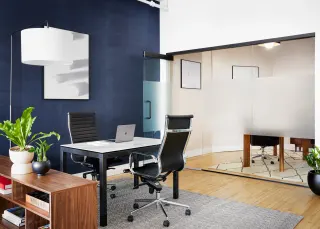 900 Broadway [Partial 9th Floor] 2,940 sq ft $92/sq ft Flatiron
 -
 54 West 21st Street [Partial 4th Floor] 3,960 sq ft $72/sq ft Flatiron
 -
 30 West 21st Street [Penthouse floor] 5,250 sq ft $115/sq ft Flatiron
 -
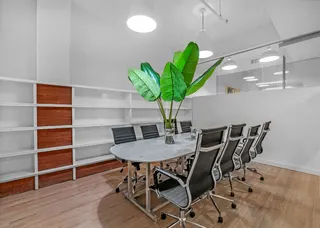 276 Fifth Avenue [9th Floor] 5,500 sq ft $52/sq ft Flatiron
 -
 137 East 25th Street [6th Floor] 8,308 sq ft $43/sq ft Flatiron
 -
 30 West 21st Street [Entire 9th & 10th Floors] 10,562 sq ft Flatiron
The team
The people you'll actually deal with
Tenant-side brokers, builders and operators, 300+ New York offices delivered between them.
Meet the whole team → William Janetschek
 Matthew DeRose
 Megan Gallagher
 Nicholas Hein
 Adam Justin
 David Greene
Talk to a broker
Availability moves daily, get today's version
The spaces above are current as of this week. Tell us team size and timing and a broker sends today's live list for this exact search, with all-in monthly costs, and anything new that has not been published yet.
- Same daya broker replies personally, no automated triage
- Tenant-onlyNomad never represents the landlord
- Open pricingrent and size published before you talk to anyone
- 300+ officesdelivered across 2M+ sq ft in New York
Or call 646-688-3158