Flatiron vs FiDi: Office Space Compared
Flatiron and FiDi price almost identically, a median of $72 against $72 per square foot per year, inside the margin you would negotiate away. The choice comes down to what is actually available: 6 spaces in Flatiron at 2,940–10,562 sq ft, against 4 in FiDi at 2,624–6,997 sq ft. Flatiron runs N/Q/R/W, 4/5/6, F/M, L at 14th and 23rd; FiDi runs 4/5, 2/3, R/W, 1, J/Z at Fulton and Wall Street; PATH and the Oculus at the World Trade Center; nearly every line within a ten-minute walk.
Updated 2026-10-01 · $72 vs $72 per sq ft · Nomad Group
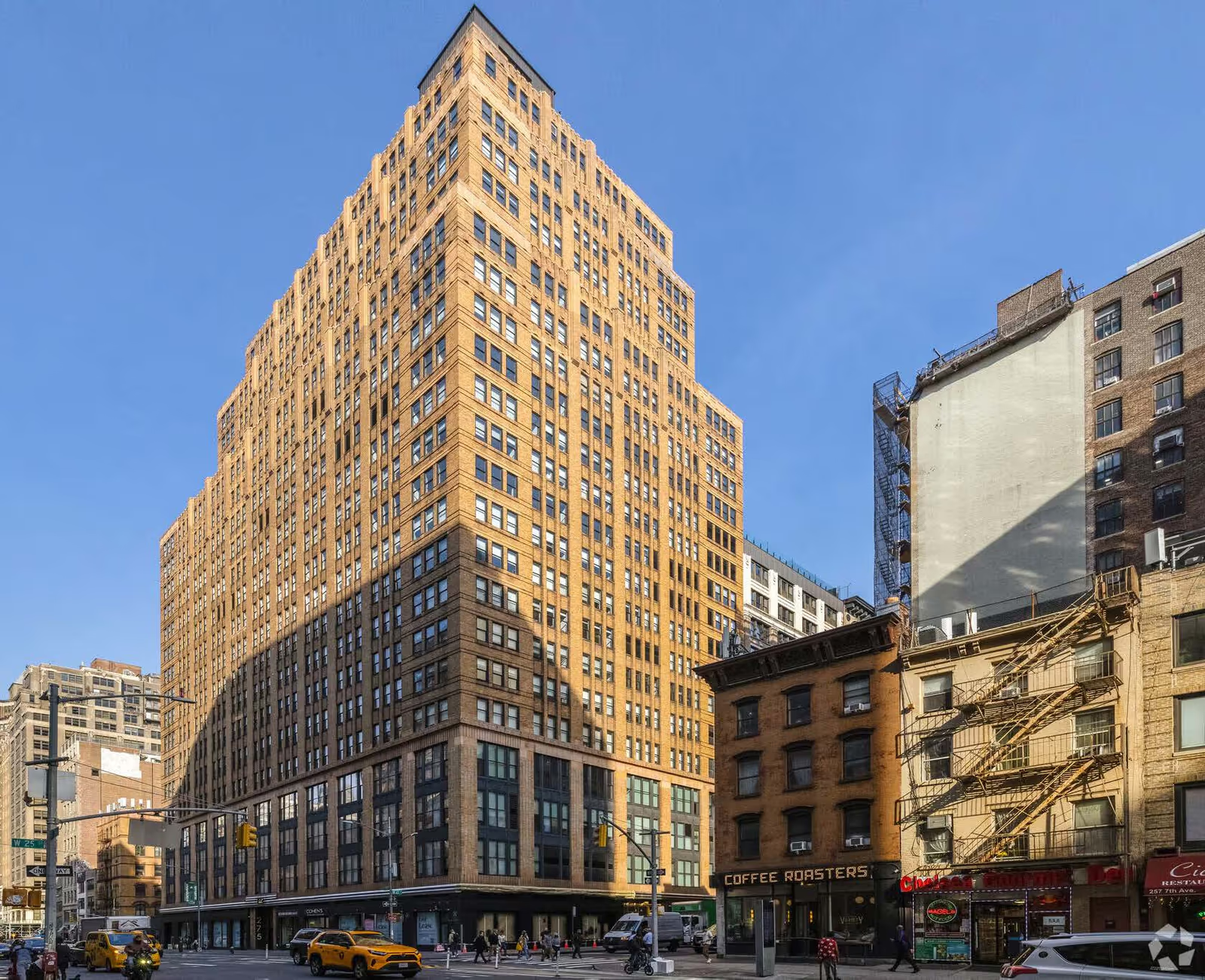
Every rent, size and count here comes from the floors Nomad represents in Flatiron and FiDi as of the date shown, with each median taken across spaces carrying a published asking rent, and the $75 benchmark is the median across our full New York book. Confirm current figures with us before budgeting.
The rent gap is fifty cents, and the fifty cents is not the story
Our Flatiron median sits at $72 per square foot per year and our FiDi median at $71.50, a difference of fifty cents that rounds to the 1% quoted above and vanishes with one month of free rent. Neither carries a premium to the $75 citywide median across our book: Flatiron sits three dollars under it and FiDi three-fifty under, so both come in a shade below the middle of our New York availability rather than anywhere near a downtown bargain. Anyone heading downtown purely to save on rent is solving a problem that does not exist at the median.
Money moves inside each market rather than between them. Flatiron availability runs $43 to $115 per square foot and FiDi runs $60 to $115, an identical ceiling over a very different floor, and that $17 gap at the bottom matters more than the fifty cents at the median. Condition drives it more than geography does: our Flatiron floors are prewar lofts with high ceilings and sparse columns, FiDi is modern tower stock with harbor views, and a raw loft needing a full buildout prices nothing like a floor the landlord has already finished. Every rent here is an asking rent, not a taking rent.
What we actually hold in each, and who fits
Six floors in Flatiron against four in FiDi is real choice rather than a rounding error, in markets that turn over a handful of well-priced floors at a time. Flatiron spans 2,940 to 10,562 square feet, about 17 to 60 desks at the 175 square feet per person we plan against. FiDi spans 2,624 to 6,997 square feet, about 15 to 40 desks. Teams of 15 to 40 people sit inside both ranges.
Above forty the comparison stops being one, because no single floor in our FiDi book seats a fifty-person company and the 10,562 square foot pair on West 21st Street does. Bear in mind that these are rentable square feet rather than usable ones, and loss factors vary enough building to building that two floors advertised at the same size can seat different headcounts. A test fit settles that in a week.
Getting there, and getting your next twenty hires there
Flatiron transit is N/Q/R/W, 4/5/6, F/M, L at 14th and 23rd. FiDi transit is 4/5, 2/3, R/W, 1, J/Z at Fulton and Wall, plus PATH at the WTC Oculus. Both are strong by any standard, and neither will be the reason a deal fails.
Commute geography decides more hiring outcomes than founders expect, since a candidate weighing two offers counts transfers, and the office reachable in one ride wins arguments the recruiter never hears about. FiDi's PATH connection is the clearest structural advantage on this page, because staff living in New Jersey reach a downtown desk without changing trains. Flatiron answers with breadth, gathering more distinct trunk lines across two station clusters, which widens the one-ride radius. Poll where your people live before you tour, weight the answer toward the twenty hires ahead of you, and let it break a tie the rent cannot.
Our recommendation, by tenant type
- Venture-backed software and product companies of 20 to 60 people: Flatiron, and we will not hedge. The sizes are there, six options beat four, and our submarket notes call it the center of the city's venture-backed tech cluster, which is a recruiting input rather than sentiment.
- Financial services, legal, insurance, and any business whose clients visit and judge: FiDi. A high tower floor with harbor views does work in a first meeting that a loft floor does not, at the same median rent.
- Teams under 20 counting every dollar: start at the Flatiron low end, because $43 per square foot exists there and nothing below $60 exists in our downtown book.
- Anyone who needs 45 to 60 desks on one floor: Flatiron by elimination, since our FiDi inventory stops at 6,997 square feet.
Someone should also pay for the expensive floor. Both markets top out at $115 per square foot, so a company taking that over a $64 floor downtown spends roughly $51 a foot on elevation and address, about a quarter of a million dollars a year on 5,000 square feet. Pay it when the office is a sales instrument and deals close in the room. It is a poor trade for a team that meets nobody, and we will say so before you sign.
The practical next step
These markets sit close enough that four to six floors across both fit into one afternoon, and seeing them back to back is the only reliable way to feel a $72 loft floor against a $72 tower floor. Tour the largest space in each first, since big floors calibrate the eye.
Ask both landlords for the same short list so the offers arrive comparable: escalation structure, how electric and cleaning are handled, the improvement allowance and free rent on offer, the security deposit, and whether a good guy guarantee is expected. We represent tenants only, we hold floors in each submarket, and we will run that comparison with you on one spreadsheet.
Is Flatiron more expensive than FiDi?
Yes, Flatiron runs about 1% higher, $72 against $72 per square foot per year. Both figures are medians of Nomad's current availability.
Which suits a growing team better?
Flatiron: The heart of Midtown South and the centre of NYC’s venture-backed tech cluster. FiDi: The Financial District: Manhattan's original downtown, where post-2000 residential conversion built a real neighborhood around the towers, and office rents run well below Midtown South for equivalent floors. The deciding factor is usually commute and the rent difference on the floor size you actually need.
How do they compare on transit?
Flatiron, N/Q/R/W, 4/5/6, F/M, L at 14th and 23rd. FiDi, 4/5, 2/3, R/W, 1, J/Z at Fulton and Wall Street; PATH and the Oculus at the World Trade Center; nearly every line within a ten-minute walk.
Can we tour both submarkets in one day?
Yes. These submarkets sit minutes apart; a well-planned tour covers four to six floors across both in an afternoon, which is the fastest way to make this comparison real.
How firm are the boundaries between these neighborhoods?
Soft. Brokers and landlords shade labels a block or two in whichever direction sounds better. Judge the block and the building, not the name on the map.
Matching space available now
-
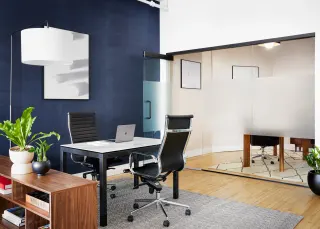 900 Broadway [Partial 9th Floor] 2,940 sq ft $92/sq ft Flatiron
 -
 54 West 21st Street [Partial 4th Floor] 3,960 sq ft $72/sq ft Flatiron
 -
 30 West 21st Street [Penthouse floor] 5,250 sq ft $115/sq ft Flatiron
 -
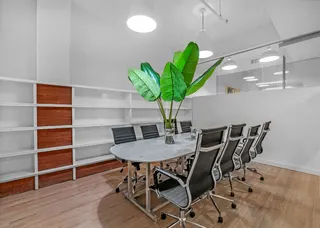 276 Fifth Avenue [9th Floor] 5,500 sq ft $52/sq ft Flatiron
 -
 137 East 25th Street [6th Floor] 8,308 sq ft $43/sq ft Flatiron
 -
 30 West 21st Street [Entire 9th & 10th Floors] 10,562 sq ft Flatiron
The team
The people you'll actually deal with
Tenant-side brokers, builders and operators, 300+ New York offices delivered between them.
Meet the whole team → William Janetschek
 Matthew DeRose
 Megan Gallagher
 Nicholas Hein
 Adam Justin
 David Greene
Talk to a broker
Availability moves daily, get today's version
The spaces above are current as of this week. Tell us team size and timing and a broker sends today's live list for this exact search, with all-in monthly costs, and anything new that has not been published yet.
- Same daya broker replies personally, no automated triage
- Tenant-onlyNomad never represents the landlord
- Open pricingrent and size published before you talk to anyone
- 300+ officesdelivered across 2M+ sq ft in New York
Or call 646-688-3158