SoHo vs Hudson Yards: Office Space Compared
SoHo office space runs a median of $98 per square foot per year against $200 in Hudson Yards, SoHo is about 51% cheaper. Nomad currently has 9 spaces in SoHo and 1 in Hudson Yards.
Updated 2026-10-01 · $98 vs $200 per sq ft · Nomad Group

Every rent, count and size range here comes from the SoHo and Hudson Yards availability Nomad represents as of this update, and the medians move whenever a floor leases. The Hudson Yards median rests on a single listing, so it is one landlord's asking rent rather than a market reading, and there is no description or floor plan on file for that floor, so nothing about its condition is asserted here. The $75 benchmark is the median asking rent across our full New York book. What a floor finally trades at depends on term, credit and concessions.
The $102 gap, between two expensive neighborhoods
The medians sit $102 apart, $98 per square foot per year in SoHo against $200 in Hudson Yards. Hudson Yards is about 104% higher; SoHo about 51% lower. On the Hudson Yards floor's own footprint of 10,517 square feet, $200 is $2,103,400 a year and about $175,283 a month, while SoHo's median across the same footage runs $1,030,666 and about $85,889. That is $1,072,734 a year, roughly $5.4 million over five years before escalations.
Neither of these is a cheap neighborhood, which is what makes the argument interesting. SoHo sits about 31% above the median across our whole New York book, so a SoHo tenant has already decided the building is part of what they are buying. This is not thrift against indulgence. It is cast-iron loft stock against the newest construction in Manhattan.
The spread is where they stop resembling each other. SoHo's nine floors run $68 to $125, so even its dearest listings, 520 Broadway and 503-511 Broadway at $125, ask $75 a foot less than the Hudson Yards floor. Hudson Yards has no spread. One floor, one number.
What the inventory in each actually looks like
Nine floors in SoHo, one in Hudson Yards. SoHo runs 3,750 to 27,344 square feet, roughly 21 to 156 desks; Hudson Yards is 10,517 square feet and about 60 desks.
- Below 7,000 square feet, seven SoHo floors, from the partial 5th at 110 Greene Street, 3,750 feet at $95, to the entire 10th at 520 Broadway, 5,539 at $125. That boutique end is where SoHo's median comes from.
- At the Hudson Yards floor's size, nothing. SoHo jumps from 7,300 square feet at 50 Greene Street to 27,344 at One Soho Square, so there is no size-for-size answer, only a smaller floor and a much larger one.
- Above it, only the partial 2nd at One Soho Square, 27,344 feet at $68. SoHo's largest floor is also its cheapest: at scale, SoHo prices below the citywide median.
So SoHo is the expensive neighborhood at boutique size and the sensible one at scale, while Hudson Yards is expensive at the single size it offers.
Getting there, and getting your next twenty hires there
SoHo's transit is N/Q/R/W, 6, A/C/E, B/D/F/M. Hudson Yards is the 7 at 34th Street Hudson Yards, with A/C/E and LIRR at Penn. They share the A/C/E, the one commute that looks much the same whichever you pick.
Past that they are opposites. SoHo is a dense downtown web, four groups of lines inside a short walk, serving a team already weighted toward Brooklyn and lower Manhattan. Hudson Yards is one subway terminal plus regional rail a few blocks east at Penn, and the rail is the real argument: a workforce arriving from Long Island stops changing trains. If none of your people commute that way, it counts for nothing.
Our recommendation, by type of tenant
For a design-led or consumer brand whose office doubles as a showroom, SoHo is the answer and it is not close. Cast-iron loft stock with high ceilings does work that would otherwise sit in a marketing budget, and at $98 you pay about 31% over the citywide median for something genuinely finite. Take the one large floor and you pay $68, under that median.
The tenant we would send to Hudson Yards is narrower. The address is part of the pitch, new construction is a requirement rather than a preference, and $2.1 million a year is a number the business carries without argument. If that does not describe your company, $1,072,734 a year saved on the same footprint in SoHo is the obvious call.
Each side costs something. SoHo plates run long and narrow, landmark rules limit what a buildout may move in some of these buildings, and freight, loading and after-hours access are the questions to ask in older loft stock. Hudson Yards offers one floor, so if it does not fit, there is no second option here.
What would make this comparison better, and how to settle it
We will not dress this up. Nine floors against one is not a comparison of two submarkets, and the Hudson Yards median is a single landlord's ask that moves the day we take on a second floor there.
Until then, settle it in an afternoon. Four to six floors in one run, sequenced so the cheapest SoHo floor and the Hudson Yards floor land on the same day, does more than any spreadsheet.
- Ask for the loss factor on every floor. Rentable and usable square feet carry the same rent and are not the same product, and at $200 a foot that difference is worth hundreds of thousands a year.
- Ask what is actually on offer at 66 Hudson Boulevard. We have no description, photography or floor plan on file for that floor, so its condition and delivery terms come from ownership on the tour.
Send us the headcount you are hiring toward, the month you need people sitting down and the number you cannot pass, and we will route both neighborhoods into one afternoon. We represent tenants only, and we publish what every floor asks, including the one most tenants should not take.
Is SoHo more expensive than Hudson Yards?
No, SoHo is about 51% cheaper, $98 against $200 per square foot per year. Both figures are medians of Nomad's current availability.
Which suits a growing team better?
SoHo: Cast-iron lofts with high ceilings, the default for design-led and consumer brands. Hudson Yards: The newest office district in Manhattan, purpose-built towers over the rail yards on the far West Side. The deciding factor is usually commute and the rent difference on the floor size you actually need.
How do they compare on transit?
SoHo, N/Q/R/W, 6, A/C/E, B/D/F/M. Hudson Yards, 7 at 34th Street Hudson Yards, A/C/E and LIRR at Penn.
Can we tour both submarkets in one day?
Yes. These submarkets sit minutes apart; a well-planned tour covers four to six floors across both in an afternoon, which is the fastest way to make this comparison real.
How firm are the boundaries between these neighborhoods?
Soft. Brokers and landlords shade labels a block or two in whichever direction sounds better. Judge the block and the building, not the name on the map.
Matching space available now
-
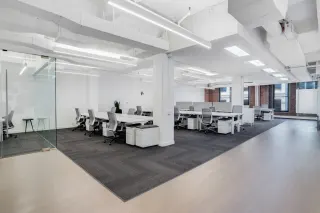 110 Greene Street [Partial 5th Floor] 3,750 sq ft $95/sq ft SoHo
 -
 6 Greene Street [Entire 2nd Floor] 4,900 sq ft $78/sq ft SoHo
 -
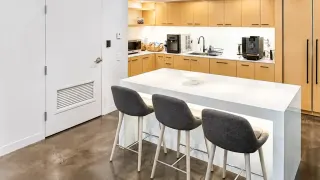 60 Charlton Street [Partial 8th Floor] 5,003 sq ft $120/sq ft SoHo
 -
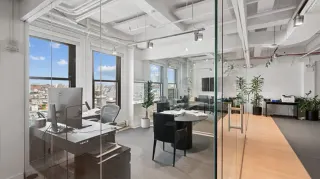 104-110 Greene Street [Partial 11th Floor] 5,375 sq ft $110/sq ft SoHo
 -
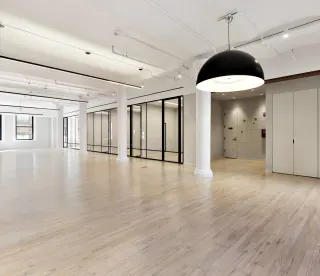 520 Broadway [Entire 10th Floor] 5,539 sq ft $125/sq ft SoHo
 -
 503-511 Broadway [Penthouse] 5,552 sq ft $125/sq ft SoHo
The team
The people you'll actually deal with
Tenant-side brokers, builders and operators, 300+ New York offices delivered between them.
Meet the whole team → William Janetschek
 Matthew DeRose
 Megan Gallagher
 Nicholas Hein
 Adam Justin
 David Greene
Talk to a broker
Availability moves daily, get today's version
The spaces above are current as of this week. Tell us team size and timing and a broker sends today's live list for this exact search, with all-in monthly costs, and anything new that has not been published yet.
- Same daya broker replies personally, no automated triage
- Tenant-onlyNomad never represents the landlord
- Open pricingrent and size published before you talk to anyone
- 300+ officesdelivered across 2M+ sq ft in New York
Or call 646-688-3158